
Hearing a sudden hiss from your range right before dinner or while prepping holiday meals is enough to make any homeowner freeze. While a gas stove making a hissing noise can signal an active gas leak that needs immediate attention, it is also frequently caused by harmless issues like a partially clogged burner port, trapped water from cleaning, or a knob that got bumped slightly out of the off position. Walking through these six safety-first checks will help you figure out what is happening and when to step back.
Safety First: Before you touch or inspect any part of your stove, pause and smell the air. If you smell the distinct rotten-egg odor of natural gas or propane, or if the hissing sound continues while all burner knobs are turned completely off, do not flip any light switches, unplug the appliance, or use electronics. Evacuate everyone from the house immediately and call your gas utility company or 911 from outside.
1. Rule Out an Active Gas Leak First
Your very first priority is determining whether raw fuel is escaping while the stove is off. A leak at the shut-off valve, pressure regulator, or internal manifold will often produce a steady, quiet hiss behind or beneath the appliance even when no burners are in use.
- Stand near the range and sniff for the sulfur or rotten-egg scent added to household gas.
- Look closely at every burner knob on the front panel or backguard to confirm each one is clicked firmly into the OFF position.
- Listen to where the sound originates: a hiss coming from behind the range against the wall is much more urgent than a hiss at a single lit burner head.
- If all knobs are off and the stove still hisses—even without a strong odor—shut off the red or yellow manual gas valve behind the stove only if it is easily reachable without moving the range. Otherwise, leave the home and call your gas company.
2. Check for Bumped or Sticky Burner Knobs
If you only hear a soft hiss when standing right in front of the stove—and you catch a faint whiff of gas—one of the control knobs may not be fully seated in its off detent. Cooking grease and splatters frequently build up around the valve stems, keeping a knob from springing completely shut when turned.
- Push each burner knob inward and twist it slightly left and right until you feel it lock into the OFF notch.
- If the hissing stops immediately, open a couple of kitchen windows to clear the air for 10 minutes before lighting any burner.
- Once the stove is cool and off, pull the knobs straight off their metal stems.
- Wipe the undersides of the knobs and the bezels on the control panel with warm, soapy water to remove sticky grease residue.
- Slide the knobs back on and verify they turn and click smoothly without binding.
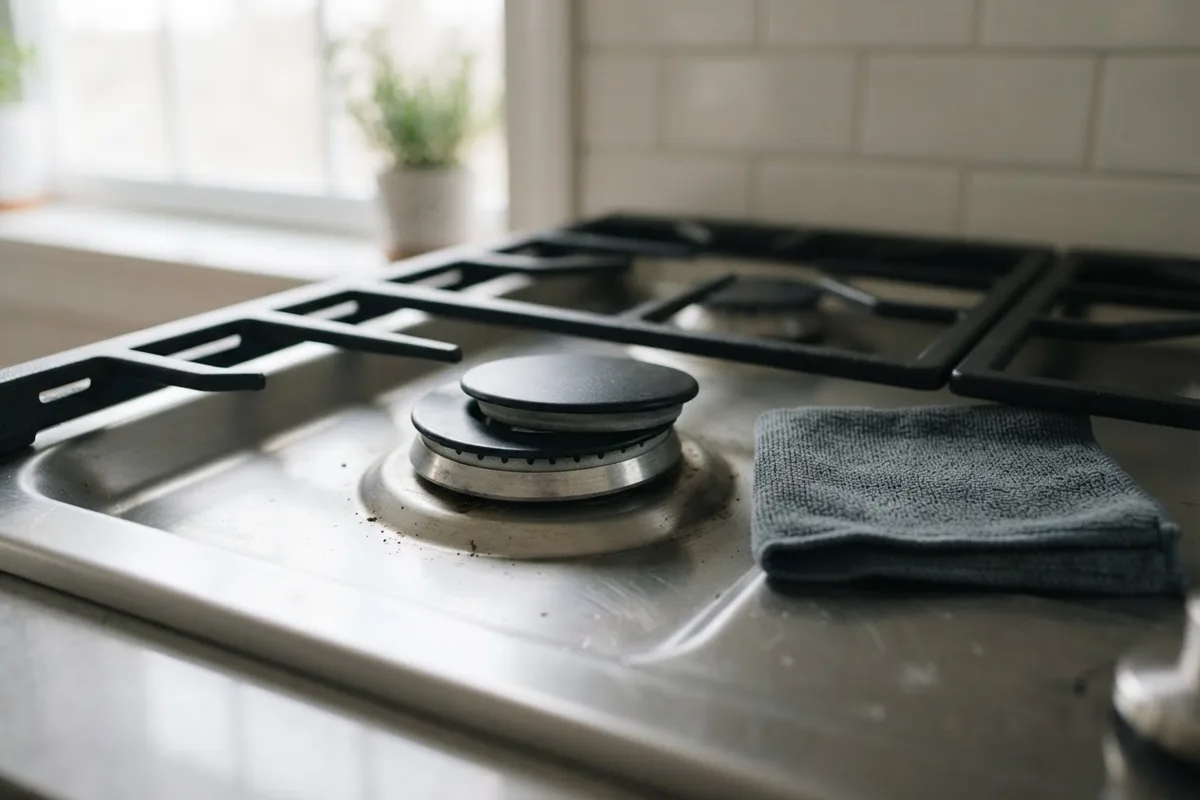
3. Clear Clogged Burner Ports and Caps
When a gas stove hisses only while a burner is lit, the culprit is almost always restricted airflow at the burner head. Boiled-over pasta water, grease, or leftover baking soda from deep cleaning an oven without self-clean can partially block the tiny slots around the burner ring. Instead of flowing smoothly, the gas jets out under higher velocity through the remaining open holes, creating a sharp hissing or whistling noise.
- Turn all burners off, unplug the range from the wall outlet, and wait until the grates and burner caps are completely cool to the touch.
- Lift off the cast-iron grates and remove the flat ceramic or metal burner cap from the noisy burner.
- Inspect the small notches and holes around the aluminum burner head.
- Use a wooden toothpick, a stiff nylon brush, or a straightened paperclip to gently poke debris out of each port. Never use a wooden matchstick or anything that can snap off inside the port.
- Wash the burner cap and removable head in warm dish soap, dry them thoroughly with a towel, and set them back in place.
4. Realign Misplaced Burner Caps
Even a spotless burner will hiss, roar, or shoot out ragged orange flames if the removable cap on top of the burner head is sitting just a millimeter off-center. After wiping down the cooktop, it is very easy to set a cap back down slightly tilted or swap two differently sized caps by mistake.
- Make sure the burner is off and completely cool.
- Look at the noisy burner at eye level to see if the dark cap sits completely flat and flush on the silver burner base.
- Try sliding the cap gently side to side with your fingers. When seated properly, a retention lip or pins on the bottom of the cap should keep it from sliding off.
- Check that you have not accidentally placed a medium burner cap on a large simmer or power burner base.
- Light the burner briefly to confirm the flame forms a quiet, even ring of blue cones.
5. Dry Out Moisture After Cleaning or Boil-Overs
If the hissing started right after a pot boiled over or right after you scrubbed the stovetop, you are likely hearing trapped water turning into steam. Moisture collects inside the recessed bowl beneath the burner head or around the white ceramic igniter electrode, sputtering and hissing as the metal heats up.
- Turn the burner off and let the grates cool.
- Remove the grate and burner cap to inspect the burner base and the recessed drip area underneath.
- Blot up any standing water with a dry microfiber cloth or paper towel.
- Leave the burner cap off for 30 to 45 minutes so air can evaporate lingering dampness around the igniter and gas orifice.
- Reassemble the burner and light it; any minor steam hiss should vanish within the first 60 seconds of heating.
6. Inspect for High Gas Pressure or Regulator Issues
Sometimes every burner on the cooktop hisses loudly at once, and the flames look unusually tall, liftoff-prone, or tipped with yellow instead of steady blue. This often points to a failing gas pressure regulator on the back of the range or an incorrect orifice setup if the stove was recently converted from natural gas to liquid propane (LP).
- Light two separate burners and observe the flames and sound together.
- Healthy natural gas flames should be mostly blue with tiny light-blue centers, burning quietly at about half an inch to an inch high on medium-high.
- If all flames roar, hiss loudly, or appear to blow themselves slightly off the burner ports, turn the burners off right away.
- Do not attempt to adjust the pressure regulator or brass orifices yourself—gas pressure calibration requires specialized manometer gauges and hands-on training.
| Hissing Symptom | When It Happens | Most Likely Cause | Safe Homeowner Action |
|---|---|---|---|
| Hiss + rotten-egg smell | Stove is completely OFF | Active gas line or valve leak | Evacuate immediately; call gas utility from outside |
| Soft hiss near control panel | Stove appears OFF | Burner knob bumped or stuck slightly open | Push and click all knobs firmly to OFF; air out room |
| Sharp hiss at one burner | Only while that burner is ON | Clogged burner ports or crooked burner cap | Cool stove, realign cap, and clean ports with a toothpick |
| Sputtering hiss + clicking | Right after a spill or cleaning | Water trapped in burner head or igniter | Wipe dry and let air-dry for 30–45 minutes |
| Loud roaring hiss on all burners | Whenever multiple burners are ON | Faulty gas pressure regulator or wrong LP orifice | Turn stove off and schedule professional service |
When to Call a Pro
Cleaning food debris out of burner slots or straightening a crooked cap are safe, simple tasks for any homeowner. However, you should stop immediately and call a professional technician if the hissing comes from inside the range cabinet, behind the control panel, or from the flexible gas connector behind the stove. Internal burner valves, manifold tubing, and gas pressure regulators are never DIY projects, just as electrical issues like an electric oven sparking beyond a simple element check call for professional tools.
Replacing a faulty surface burner valve or a gas pressure regulator typically costs between $150 and $350 including parts and labor, though exact pricing varies by area and model. If your range needs internal valve work or regulator replacement, True Appliance Repair can connect you with an experienced local technician through our oven and stove repair service page to get your kitchen cooking safely again.
FAQ
Is it normal for a gas stove to make a slight hissing sound when lit?
A very faint, steady rush of sound is normal when a large power burner is turned all the way to high, because a high volume of gas is moving through the orifice. However, it should sound like a gentle whoosh rather than a sharp hiss or whistle, and the flames should remain steady and blue. If the sound suddenly gets louder or only happens on one specific burner, check for clogged ports or a shifted burner cap.
Why is my gas stove hissing when it is turned off?
A gas stove should be completely silent when all burners and the oven are turned off. If you hear hissing while the stove is off, first verify that none of the burner knobs were accidentally bumped slightly open. If all knobs are firmly in the off position and the hissing continues, leave the house immediately without touching any electrical switches and call your gas utility company.
Can a dirty gas burner cause a hissing noise?
Yes, baked-on grease and food spills are the most common harmless cause of a hissing burner while cooking. When half of the small flame slots on the burner head get plugged with debris, gas is forced through the remaining open slots at higher pressure, which creates a whistling or hissing sound. Unplugging the stove once cool and clearing those slots with a toothpick usually solves the problem.
Why does my propane stove hiss louder than a natural gas stove?
Liquid propane operates at higher pressure than municipal natural gas, so LP ranges naturally produce a slightly more noticeable flow sound on high heat. However, if a newly installed stove hisses loudly and produces tall, sooty yellow flames, the range may still have natural gas orifices installed instead of the smaller propane conversion orifices. Turn the stove off and have an appliance technician verify the conversion kit.