
Discovering that your oven refuses to shut down after you press cancel is an alarming experience that demands immediate action. When heating elements stay red-hot or the unit continues cycling, internal electrical components have failed to break the circuit. Follow this practical guide to cut power safely, isolate the faulty component, and restore complete control over your appliance.
Cut Circuit Power and Perform a Hard Reset
When an oven ignores the cancel button, your first priority is removing electricity before the appliance overheats your kitchen. Do not attempt to touch glowing elements or disassemble panels while power flows to the unit.
- Walk to your home electrical service panel and locate the dedicated double-pole breaker labeled for your range or oven.
- Flip the breaker switch firmly into the full off position. If you have an accessible freestanding electric range with a cord, you can carefully pull the unit forward and unplug the heavy-duty cord from the wall receptacle.
- Wait at least ten to fifteen minutes with the power disconnected. This extended pause allows internal microprocessors to discharge lingering voltage and clears temporary electronic memory glitches.
- Restore power at the breaker panel. Listen closely for any clicking sounds and inspect the display.
If the heating element instantly begins glowing bright red without anyone touching the keypad, turn the breaker off immediately. That instant heat confirms a physical hardware short rather than a soft digital error.
Inspect for a Welded Relay on the Control Board
The electronic control board functions as the central brain of a modern range, using small mechanical switches called relays to send high-voltage current to the bake and broil elements. Over years of thermal cycles, these internal relay contacts can arc, melt, and weld themselves shut in the closed position.
- Disconnect all electrical power at the breaker panel before touching any access covers.
- Pull your range away from the wall to access the rear metal panel, or remove the upper console trim using a Phillips screwdriver or nut driver.
- Locate the main electronic control board mounted behind the digital clock and touchpad assembly.
- Inspect the board under a bright flashlight for telltale signs of failure: blackened solder joints, scorched resin, or swollen plastic relay boxes.
- If a relay has fused shut, replacing the individual board relay requires micro-soldering experience that most homeowners avoid; replacing the entire electronic control board assembly typically costs between $120 and $300 for the part itself, depending on your model.
Check for a Grounded or Blistered Heating Element
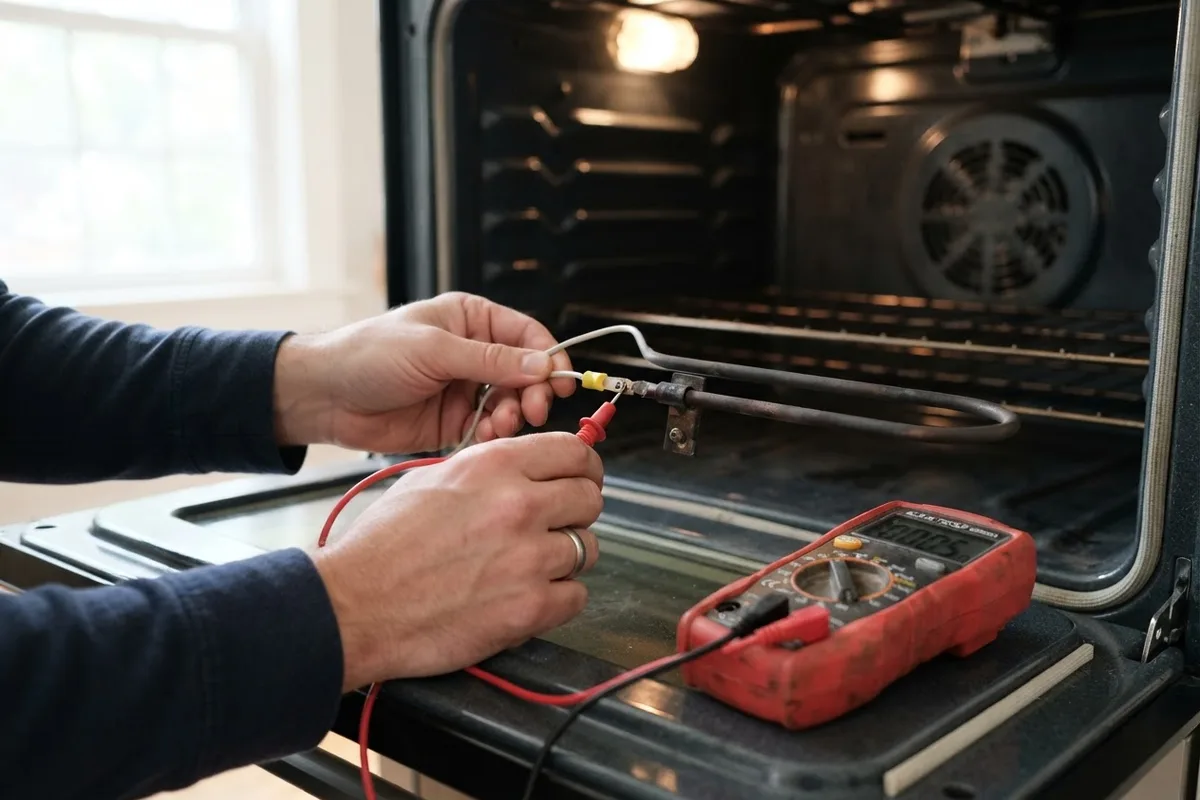
Electric bake and broil elements consist of an internal nickel-chromium resistance wire surrounded by magnesium oxide insulation inside a heavy outer metal sheath. If that inner wire breaks and touches the outer casing, electricity can bypass the control board and flow directly to ground, leaving the element stuck on high whenever the unit receives power.
- Confirm the circuit breaker remains completely switched off.
- Open the oven door, pull out the sliding wire racks, and inspect the lower bake element and upper broil loop.
- Look for visible bubbling, blistering, pitted holes, hairline fractures, or thinning spots along the metal tubing.
- Unthread the two retaining screws holding the element mounting bracket to the rear oven cavity wall.
- Gently ease the element forward an inch or two until the slip-on wire terminals emerge through the access holes. Use needle-nose pliers to disconnect the push-on terminals, taking care not to let the cabinet wires slip back into the wall cavity.
- Set a digital multimeter to the lowest ohms setting (or continuity mode). Touch one test probe to a terminal spade and the other probe to the metal outer bracket. The meter should show infinite resistance (open line / OL). Any reading or continuity beep proves the element has shorted to ground and must be replaced.
If you noticed an acrid odor right before the failure, reviewing why an oven smells like burning plastic can help clarify whether wiring insulation melted inside the back cavity.
Test the Oven Temperature Sensor Probe
A malfunctioning resistance temperature detector (RTD) can feed false cold signals to your control board, making the system believe the cavity has not reached target temperature. When the computer believes the interior is cold, it keeps the heating relays energized indefinitely.
- Ensure circuit power is off and the oven cavity has cooled down completely to ambient room temperature (approximately 70°F).
- Locate the narrow metal probe extending from the upper rear corner inside the cooking chamber.
- Remove the two mounting screws holding the probe faceplate to the rear cavity wall, then pull the probe forward until the plastic wire harness connector emerges.
- Unplug the molex wiring harness and pull the sensor out of the oven.
- Place digital multimeter probes into the two terminal pins of the sensor harness. At a standard room temperature of 70°F to 75°F, a standard range sensor should measure between 1,050 and 1,100 ohms of resistance.
If your meter displays zero ohms, an open loop (OL), or a number significantly outside that range, the probe has degraded. An inaccurate sensor can also leave an oven not reaching temperature or cause severe overbaking during standard cooking cycles.
Replace a Failed Infinite or Selector Switch
On ranges with manual mechanical knobs rather than digital touchpads, an infinite switch or rotary selector regulates power to heating elements. Internal bi-metal contacts inside these mechanical switches can pit, deform, or fuse together permanently after repeated high-heat exposure.
- Verify power is shut down at the main breaker panel.
- Pull the control knob straight off the front shaft of the affected switch.
- Remove the rear console panel to reach the switch body secured behind the front dashboard.
- Label each colored wire with masking tape before unplugging the spade connectors to ensure accurate reassembly.
- Unscrew the mounting nuts or screws securing the switch to the control console frame.
- Inspect the switch casing for heat discoloration or a distinct burnt electrical odor. A jammed mechanical switch will constantly route full line voltage to your heating surface or oven loop regardless of knob position.
| Symptom | Probable Cause | DIY Difficulty | Common Solution |
|---|---|---|---|
| Element heats up immediately upon breaker reset | Fused control board relay | Moderate | Replace control board |
| Single coil glows red regardless of control input | Grounded heating element | Beginner | Swap out bake/broil element |
| Oven runs continuously without cycling off | Faulty temperature sensor probe | Beginner | Replace 1,100-ohm RTD probe |
| Manual knob turns but switch never clicks off | Welded infinite selector switch | Moderate | Install new rotary switch |
| Electronic display locked on active cycle | Microprocessor software lockup | Beginner | Perform 15-minute breaker reset |
When to Call a Pro
While swapping a plug-and-play bake element or RTD sensor is well within the reach of a handy homeowner, working behind control consoles and around 240-volt circuits requires strict safety boundaries. If you smell raw natural gas or propane, do not operate switches or phones in the room; evacuate immediately, shut off your exterior supply valve, and contact your utility company.
Call an expert if you encounter melted main wiring harnesses, damaged terminal blocks, persistent breaker trips, or if troubleshooting points toward intricate electronic circuit boards. Typical appliance repair visits across the US run between $150 and $350 for labor and diagnosis, with part prices varying by brand and vintage. If you prefer experienced hands to diagnose high-voltage range issues, True Appliance Repair can match you with an independent local technician for reliable oven and stove repair.
FAQ
Can a faulty oven catch fire if it won't shut off?
Yes. An oven that runs indefinitely can generate extreme interior temperatures, char food remnants, degrade door seals, and overheat nearby cabinetry. If your oven will not turn off, flip the dedicated circuit breaker immediately rather than leaving the appliance unattended.
Why does my oven fan keep running long after I turn it off?
Many modern convection and wall ovens use an independent cooling fan that expels hot air from electronic compartments. This circulation fan operates on a separate thermal switch and typically runs for 20 to 60 minutes after cooking has ended until internal components cool below roughly 150°F.
Is it safe to unplug an electric range while it is running?
It is safer to switch off the circuit breaker at your main electrical panel first. Pulling a high-amperage 240-volt plug out of a wall receptacle while heavy electrical current is flowing can generate dangerous electrical arcing and damage the outlet prongs.