
Opening the freezer to find soft ice cream and thawing meat is frustrating, especially when the fresh food compartment right next to it feels perfectly chilled. When your refrigerator is cold but the freezer is warm, the culprit is usually an airflow restriction, a dirty coil, or a minor defrost glitch rather than a total breakdown. Follow these five step-by-step checks to find the cause and get your freezer back to zero degrees.
Safety First: Before inspecting internal fans, removing back panels, or cleaning underneath the unit, always unplug the refrigerator from the wall outlet or turn off its circuit breaker. If your water line is attached, shut off the water supply valve before pulling the unit away from the wall. Never attempt sealed-system refrigerant work or electrical panel repairs yourself.
1. Clear Blocked Freezer Air Vents and Overpacked Shelves
Modern refrigerators and freezers rely on continuous air circulation to maintain steady temperatures. While the refrigerator compartment only needs to reach about 37°F to feel cold, the freezer must stay around 0°F. If grocery bags, pizza boxes, or ice bins block the internal vents, the freezer cannot circulate enough sub-zero air, causing items to thaw even while the fridge side still feels reasonably cool.
- Open the freezer door and locate the air supply and return vents along the back wall or ceiling.
- Pull food items at least two inches away from all vents so air can move freely.
- Reorganize densely packed shelves—aim to keep the freezer about 70% to 80% full rather than crammed wall-to-wall.
- Check that tall boxes or bags aren't preventing the inner drawer or door from sealing tightly when shut.
- Wait four to six hours and check the temperature with a freestanding appliance thermometer.
While you are rearranging shelves, if you notice a bin or glide is binding up, check out our guide on why your refrigerator drawer is stuck to get everything sliding smoothly again.
2. Reset the Temperature Controls and Disable Demo Mode
Modern French-door and side-by-side units use digital control boards that can accidentally get bumped into a warm setting, an energy-saver mode, or even retail "Demo/Showroom Mode" during routine wiping or power flickers. In some dual-evaporator models, the freezer control can be turned up or disabled independently while the refrigerator section continues cooling normally.
- Check the digital display or mechanical dial to confirm the freezer is set to 0°F (-18°C) and the refrigerator is set to 37°F (3°C).
- Look for indicator lights labeled "Cooling Off," "Demo," "Vacation," or "Sabbath Mode." Refer to your owner's manual for the two-button press combination required to exit these modes.
- Perform a hard reset by unplugging the refrigerator from the wall outlet.
- Wait five full minutes to allow the main control board capacitors to discharge completely.
- Plug the unit back in and listen for the compressor and internal fans to engage within two to three minutes.
If unplugging and plugging the unit back in causes the outlet or breaker to snap off immediately, stop and read our troubleshooting steps for why your refrigerator is tripping the breaker.
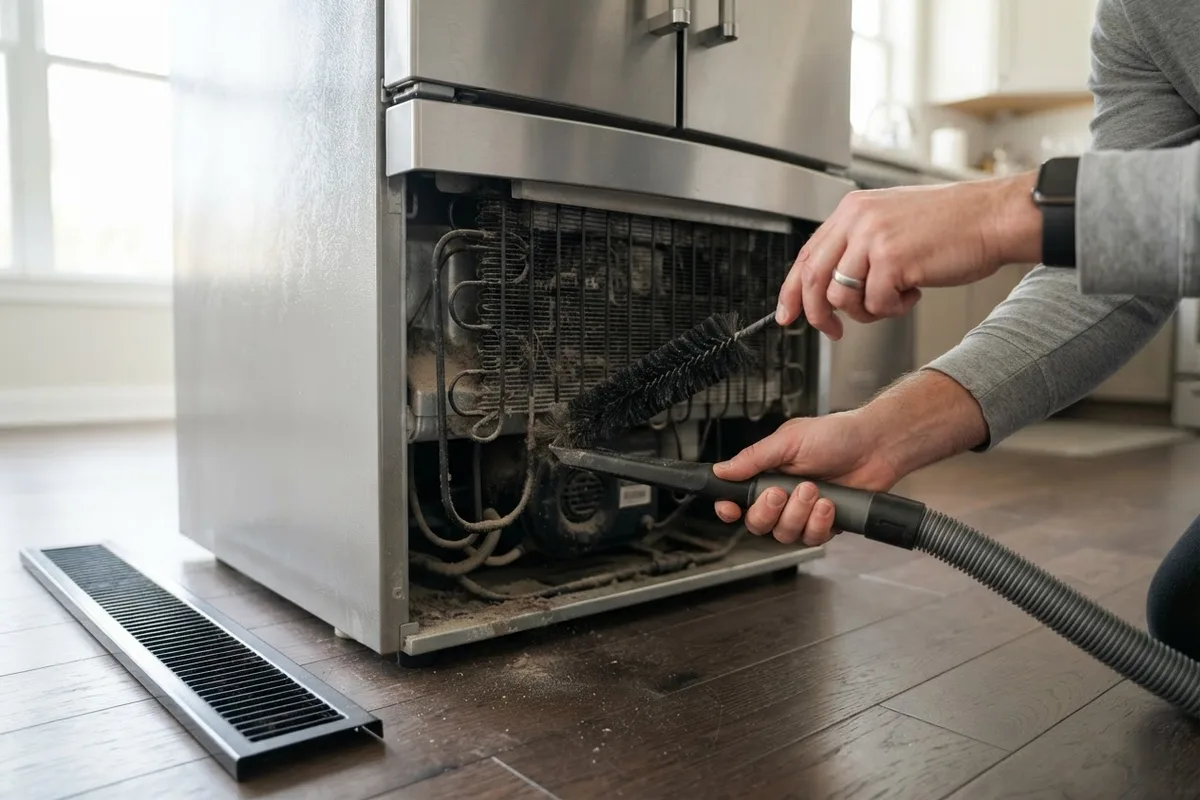
3. Vacuum Dusty Condenser Coils Under the Fridge
When condenser coils are coated in pet hair, kitchen grease, and dust, the refrigerator cannot release heat efficiently into the room. Because keeping a freezer at 0°F requires far more heat rejection than keeping a fridge at 37°F, dirty coils often show up first as a warming freezer—your fridge still feels cool to the touch, but the system simply cannot pull the freezer down below freezing.
- Unplug the refrigerator from the wall outlet.
- Locate the coils—they are either behind the lower front toe-kick grille or behind a thin access panel on the lower back of the cabinet.
- Remove the toe-kick grille by unsnapping it or unscrewing the two retaining screws.
- Use a long, flexible condenser coil brush to gently loosen compacted dust and pet hair from between the metal fins, being careful not to puncture any tubing.
- Vacuum up all loose debris with a crevice attachment, wipe the condenser fan blades with a damp cloth, and reattach the grille before restoring power.
4. Check the Freezer Evaporator Fan and Defrost System
Behind the back wall of your freezer sits the evaporator coil and the evaporator fan. If frost builds up heavily on the coil—or if the fan motor fails—sub-zero air remains trapped behind the panel instead of blowing into the freezer cavity. Meanwhile, residual cold or a secondary fridge evaporator keeps the fresh food compartment cool.
- Unplug the refrigerator and remove all food and shelving from the freezer.
- Inspect the back interior wall of the freezer for visible white frost sheets or ice buildup.
- Press the freezer door switch with your finger (with the power temporarily restored if needed for listening, keeping hands clear of moving parts) to hear if the evaporator fan whirs quietly behind the wall. Unplug the unit immediately afterward.
- If the back wall is encased in ice, the defrost heater, defrost thermostat, or thermistor has likely failed, trapping the cold air.
- For a one-time glitch, leave the unit unplugged with the freezer door open and towels on the floor for 12 to 24 hours to melt the ice completely, then plug it back in.
5. Inspect the Freezer Door Gasket and Drawer Tracks
Pull-out bottom freezers are notorious for sneaking open just a fraction of an inch. A stray bag of frozen peas falling behind the basket or a stiff, dirty rubber gasket lets warm, humid kitchen air seep continuously into the freezer. Because the fresh food doors above are still sealed tight, the fridge stays cold while the freezer turns into a slushy mess.
- Open the pull-out freezer drawer or door and use a flashlight to look completely underneath and behind the sliding baskets for fallen food packages or ice cubes.
- Wipe the entire rubber door gasket with warm, soapy water to remove sticky spills that pull the seal out of alignment.
- Close the freezer door on a dollar bill at several points around the perimeter—top, bottom, and both sides.
- Pull the bill out; if it slides out with zero resistance, the magnetic strip inside the gasket is weak or warped.
- Gently warm stiff sections of the rubber gasket with a hairdryer on low heat (keeping it moving so the vinyl doesn't melt) and rub a thin dab of petroleum jelly along the hinge side to help it seat flush.
Quick Diagnostic & Typical Repair Cost Guide
Use this table to match your symptoms to the most likely cause and see broad typical US repair ranges (costs vary by region, appliance brand, and model).
| Freezer Symptom | Most Likely Cause | DIY vs. Pro | Typical US Repair Range (Varies by Area/Model) |
|---|---|---|---|
| Soft ice cream, vents blocked by boxes | Poor airflow / overpacking | Easy DIY | $0 (Reorganize shelves) |
| Heavy frost on back freezer wall, no fan sound | Failed evaporator fan motor | DIY or Pro | $150 – $350 |
| Ice buildup returns a week after manual defrost | Bad defrost heater or sensor | Pro recommended | $180 – $400 |
| Frost droplets around door frame, loose seal | Warped or torn door gasket | Easy DIY | $80 – $220 |
| Both compartments eventually warm, loud clicking | Sealed system, start relay, or compressor | Pro only | $250 – $900+ |
When to Call a Pro
If you have cleared the vents, cleaned the condenser coils, and verified the door seal, yet the freezer still won't drop below freezing, the issue likely involves a failed evaporator fan motor, a faulty three-way diverter valve (common on dual-evaporator French-door fridges), or a slow sealed-system refrigerant leak. Testing multi-wire DC fan motors, replacing defrost heaters, and handling refrigerants require specialized gauges and electrical testing gear.
Never attempt to open refrigerant tubing or bypass high-voltage control relays yourself. Instead, schedule a refrigerator repair check so an experienced technician can pinpoint the exact component. True Appliance Repair can match you with an independent local appliance pro who can diagnose the cooling system and get your freezer running properly again.
FAQ
Why is my bottom freezer warm when the top fridge is cold?
Bottom-freezer and French-door models often have separate evaporator coils or a motorized damper that splits airflow between compartments. If the freezer evaporator fan dies, the freezer drawer doesn't close fully on its tracks, or the diverter valve gets stuck feeding only the fresh food section, the fridge will stay cold while the bottom freezer warms up.
How long does it take a freezer to get cold again after cleaning coils or resetting?
Once you restore power and proper airflow, you should feel cold air blowing from the freezer vents within 15 to 30 minutes. However, it typically takes 4 to 6 hours for the freezer cavity to drop back down to 0°F, and up to 24 hours for temperatures to fully stabilize.
At what temperature is freezer food no longer safe to refreeze?
According to standard food safety guidelines, frozen food that still contains ice crystals or feels refrigerator-cold (40°F or below) can safely be refrozen or cooked immediately. If meat, poultry, or dairy has sat above 40°F for more than two hours, discard it to avoid foodborne illness.
Can low refrigerant cause the freezer to warm up before the fridge?
Yes, a slow refrigerant leak reduces the system's overall cooling capacity. Because reaching 0°F in the freezer requires a much colder evaporator coil than maintaining 37°F in the refrigerator, a low charge will cause the freezer to thaw out first while the fridge compartment temporarily feels cool.