
Opening your fresh food compartment only to find frozen lettuce, slushy milk, or ruined eggs is an irritating household surprise. While your freezer compartment is designed to store items at sub-zero temperatures, the main fresh food cabinet should maintain a crisp chill without turning fresh groceries into ice blocks. Most household refrigerators perform best when set between 37°F and 40°F (3°C to 4°C). When internal temperatures drop below the 32°F (0°C) freezing threshold, delicate produce, dairy products, and liquids freeze rapidly, leading to food waste and frustration.
Fortunately, a refrigerator freezing food in the main section is usually caused by simple airflow disruptions, misadjusted controls, dirty components, or minor mechanical misalignments rather than a completely failed appliance. Before throwing out spoiled produce or scheduling a service visit, you can easily troubleshoot the issue yourself using basic household tools. In this guide, we cover five practical DIY fixes to stop your fridge from freezing food and restore proper cooling balance to your kitchen.
Adjust the Temperature Control Settings
The most common cause of frozen food in the fresh section is an accidentally altered temperature setting. Dials or digital touchpads inside the cabinet are easily bumped when loading large grocery bags, tall beverage containers, or bulky storage boxes, inadvertently setting the cooling output far lower than intended.
Factory default settings typically recommend keeping the fresh food section at 37°F to 38°F. If your appliance uses a manual control dial marked 1 through 5 (or 1 through 9), it is easy to misunderstand the numbers. On almost all refrigerator dials, the highest number represents the coldest cooling level, not the warmest setting. Setting the dial to 5 or 9 forces the compressor to run much longer than necessary.
- Locate your temperature control panel, usually found inside the top frame assembly or upper side wall of the fresh compartment.
- Verify the target temperature setting. Adjust digital controls to 38°F, or set manual control dials to the middle position (typically setting 3 or 4).
- Place a standard glass of water with an accurate thermometer inside on the middle shelf to measure actual liquid temperature after several hours.
- Wait a full 24 hours before rechecking the temperature reading, as refrigerator cooling systems adjust slowly to manual control changes.
Unblock the Fresh Food Air Vents
Refrigerators rely on forced cold air circulation to maintain consistent cooling across all interior shelves. Cold air generated by the evaporator coils inside the freezer section flows into the fresh food cabinet through dedicated air diffusers or louvers, usually positioned along the upper rear wall or top corners of the compartment.
When items like bags of salad, milk jugs, or glass bottles are pushed directly against these vent openings, they intercept the incoming stream of freezing air. This causes items stored directly in front of the vent to freeze solid. At the same time, blocking these pathways prevents cold air from circulating downward, which tricks the internal thermostat into keeping the compressor running continuously.
- Inspect the rear wall and upper shelf area of the refrigerator interior to identify all air vent discharge locations.
- Rearrange container placement so there is at least 5 to 6 inches of clear space surrounding all air vents.
- Avoid overpacking shelves to capacity. Leave open space around containers and wire baskets so circulating air can move downward to the lower crisper drawers.
- Store delicate produce like lettuce, herbs, and tomatoes in the dedicated crisper drawers, which provide humidity control and protection from direct cold drafts.
Clean and Inspect the Magnetic Door Seal
A damaged, brittle, or dirty door gasket allows warm, humid kitchen air to continuously leak into the refrigerated compartment. In response to this constant heat gain, the cooling system works overtime to maintain internal temperatures, causing the compressor to run almost non-stop. This continuous operation drives localized cabinet zones below the freezing mark, particularly on shelves near the incoming cold air vents.
If you have noticed your fridge running continuously without shutting off, addressing seal issues is crucial. You can learn more about managing continuous cooling cycles in our guide on refrigerator running constantly fixes.
- Open the refrigerator door and inspect the flexible rubber gasket around the entire outer door border for visible cracks, gaps, or mold buildup.
- Clean sticky food spills, crumbs, and debris off the rubber door gasket using a soft sponge dipped in warm water and mild dish soap.
- Perform the paper seal test: close the door on a dollar bill or thin strip of paper. If you can pull the paper out easily with no resistance, the magnetic strip inside the gasket has weakened or the rubber has warped, requiring door gasket replacement.
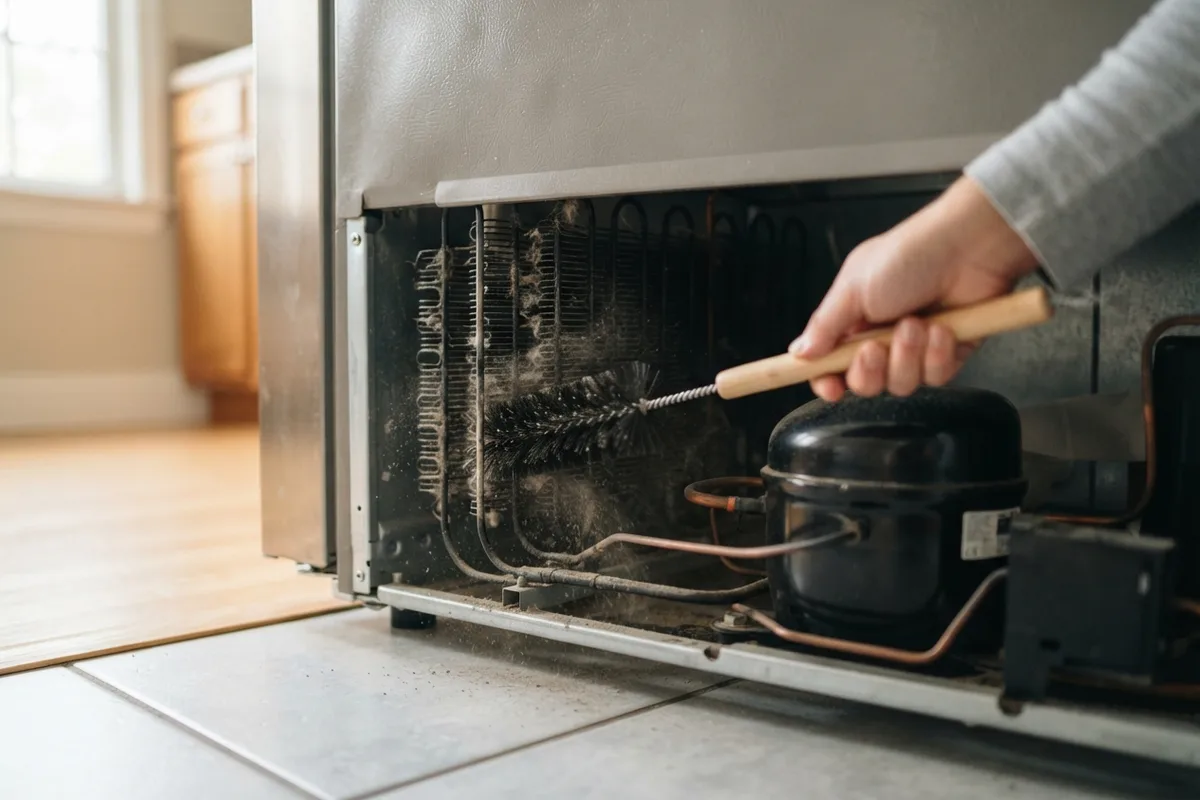
Clean Dust from the Condenser Coils
Condenser coils dissipate heat extracted from inside the cabinet into the surrounding kitchen air. When these metal coils accumulate a thick coating of dust, lint, and pet hair, heat exchange efficiency drops significantly. The refrigeration system reacts by running longer cooling cycles to force heat removal, which distorts cabinet temperature management and creates localized sub-zero freezing pockets inside the fresh food section.
Before performing any hands-on maintenance beneath or behind your appliance, safety comes first: always unplug the refrigerator from the wall electrical outlet or switch off the dedicated circuit breaker in your home panel.
- Disconnect the refrigerator power cord safely from the wall electrical outlet.
- Locate the condenser coils, which are typically found behind a removable front toe-kick grill or behind an access panel on the rear exterior bottom.
- Use a long, flexible coil cleaning brush along with a narrow vacuum hose attachment to gently sweep away dust and pet hair buildup from the wire coils.
- Carefully vacuum up loose debris from the floor beneath the cabinet, reinstall the access grill, slide the unit back into position, and plug the power cord back into the wall outlet.
For a complete step-by-step coil cleaning guide, refer to our detailed article on how to clean refrigerator coils.
Test the Temperature Sensor and Damper Door
Modern refrigerators use a temperature sensor (thermistor) to monitor internal air temperature and an automated baffle door (air damper) to regulate how much sub-zero freezer air enters the fresh food section. If the thermistor sends inaccurate resistance readings to the main electronic control board, or if the motorized damper door becomes stuck in the open position, frozen air continuously pours into the fresh compartment without stopping.
- Disconnect power to the appliance at the electrical outlet before inspecting internal mechanical components.
- Locate the air damper assembly, typically housed inside the plastic air duct lining near the top rear section of the fresh food compartment.
- Visually inspect the damper housing for ice accumulation that may be blocking the flap from closing. If frost or ice is present, use a hair dryer on its lowest heat setting to melt the obstruction, then wipe away moisture completely.
- If the damper flap remains mechanically jammed open or fails to move during cooling cycles, the damper assembly or thermistor needs replacement.
Quick Reference: Refrigerator Freezing Causes & Solutions
| Issue / Symptom | Primary Cause | Recommended DIY Solution | Difficulty Level |
|---|---|---|---|
| Food freezing near air vents | Direct blast of freezer air | Move food 6 inches away from vents | Very Easy |
| Overall cabinet temperature below 32°F | Low thermostat setting | Adjust digital temp to 38°F–40°F | Very Easy |
| Frost buildup & overcooling | Faulty door gasket seal | Clean gasket or perform paper seal test | Easy |
| Continuous running & freezing | Dust-covered condenser coils | Vacuum coils beneath or behind unit | Easy–Moderate |
| Top shelf freezing solid | Stuck open air damper flap | Defrost damper duct or replace damper unit | Moderate |
When to Call a Pro
While simple vent clearing, control dial adjustments, and coil cleaning are straightforward DIY projects for any homeowner, complex cooling issues require specialized diagnostic tools. If you have verified your temperature settings, cleared air pathways, cleaned the coils, and tested the door seals but your refrigerator continues to freeze food, the underlying issue may involve a failing thermistor, a malfunctioning electronic control board, or sealed system refrigerant flow issues.
When troubleshooting complex electrical circuits, internal wiring, or sealed refrigeration system components, always stop and call a professional technician. Never attempt to pierce sealed refrigerant lines or service internal sealed system components yourself. If you need expert assistance resolving persistent cooling issues, True Appliance Repair can match you with a local appliance pro in your area to restore your refrigerator to perfect working condition.
FAQ
What temperature should my refrigerator fresh food compartment be set to?
Your fresh food compartment should be set between 37°F and 40°F (3°C to 4°C). Temperatures in this range keep perishable groceries safely out of the bacterial growth zone without reaching the 32°F (0°C) freezing threshold.
Why is food freezing specifically inside my crisper drawers?
Crisper drawers sit at the bottom of the fresh food compartment where cold air naturally settles. If temperature controls are set too low or upper vents are blocked, cold air pools at the bottom of the cabinet and freezes dense produce stored in the drawers. Raising the target cabinet temperature by two degrees typically resolves this issue.
Can dirty condenser coils cause a refrigerator to freeze fresh food?
Yes. Dirty condenser coils prevent heat from escaping the system efficiently. To compensate, the compressor runs longer cooling cycles, which can drop cabinet air temperatures below freezing near the air intake vents.
How long does it take for a refrigerator to stabilize after adjusting temperature settings?
It takes approximately 24 hours for internal cabinet temperatures to fully balance after adjusting thermostat controls. Avoid making multiple temperature adjustments within a single day to prevent extreme temperature fluctuations.