
Hearing a sudden buzzing, clicking, or grinding sound from your kitchen can stop you in your tracks, especially when you are prepping for holiday guests. When your refrigerator ice maker starts making noise, it is usually calling attention to a minor water supply hiccup or a simple ice jam rather than a total breakdown. With a few basic household tools and about thirty minutes, you can track down the source of the racket and get your fridge running quietly again.
Safety First: Before inspecting internal parts, clearing jammed blades, or pulling your fridge away from the wall, always unplug the refrigerator from the electrical outlet and turn off the dedicated water supply valve. Never reach into an active ice maker assembly while the appliance has power.
1. Clear Jammed Ice From the Ejector Arm
If you hear a rhythmic clicking, snapping, or scraping sound every few minutes, a rogue ice cube is likely wedged in the harvesting mechanism. When cubes freeze together or land sideways, the plastic or metal ejector teeth cannot complete their rotation, causing the internal gears to skip and click repeatedly.
- Unplug the refrigerator or flip the ice maker power switch to the OFF position.
- Lift out the removable ice storage bin and dump any clumped or misshapen ice into the sink.
- Shine a flashlight into the ice mold at the top of the compartment to spot any stuck cubes.
- Pour a few tablespoons of warm (never boiling) water over the stuck cubes, or hold a hairdryer on its lowest setting about six inches away to gently melt the blockage.
- Once the ice loosens, pluck it out by hand—never pry at the mold with a knife or screwdriver, as puncturing the lining ruins the assembly.
- Dry the area with a clean towel, replace the bin, and turn the unit back on.
2. Check the Water Supply Line and Valve
A loud buzzing or humming noise that lasts for five to ten seconds every few minutes almost always points to a dry water inlet valve. The ice maker is calling for water, energizing the solenoid valve at the back of the fridge, but no water is flowing through to quiet the vibration.
- Check whether the wire shutoff arm (or paddle) on the ice maker got bumped into the DOWN (on) position when you do not even have a water line hooked up; if so, click it UP to stop the buzzing immediately.
- If your water line is connected, carefully roll the refrigerator out from the wall, taking care not to scuff your flooring.
- Locate the shutoff valve under the kitchen sink, behind the fridge, or in the basement, and confirm it is turned all the way open.
- Inspect the flexible copper or braided steel tubing behind the fridge for sharp kinks or pinches that restrict flow.
- Straighten any mild bends, or replace a creased line before pushing the fridge back into place, leaving at least two inches of clearance behind the cabinet.
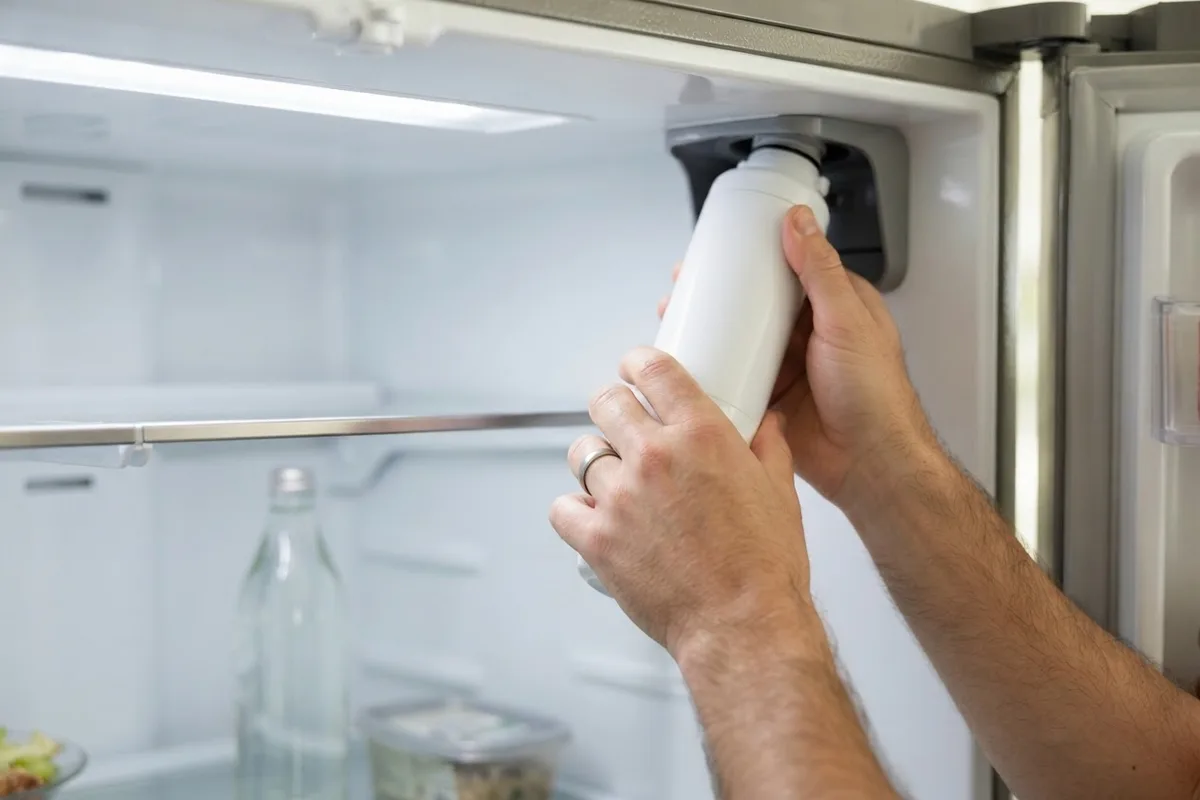
3. Replace a Clogged Refrigerator Water Filter
When a water filter becomes packed with sediment and mineral scale, water pressure drops dramatically. That starvation forces the inlet valve to chatter, vibrate, or buzz loudly every time the ice mold tries to fill, and it can also leave you wondering why your refrigerator water is tasting bad.
- Locate your filter housing, typically in the upper-right ceiling of the fresh food compartment or down inside the bottom base grille.
- Place a hand towel underneath the housing to catch any drips.
- Twist the old filter a quarter-turn counterclockwise (or press the release button on push-style models) and pull it straight out.
- Remove the protective cap from a compatible replacement filter and wet the rubber O-rings with a drop of tap water.
- Slide the new filter in and twist clockwise until it locks flush.
- Run about two gallons of water through the door dispenser to purge trapped air pockets—air in the line will make the ice maker sputter and bang during the first few cycles.
4. Thaw a Frozen Ice Maker Fill Tube
If you hear a dull thud followed by a brief buzz—and notice your ice bin is completely empty—the small rubber or plastic fill tube that feeds water into the ice mold may be frozen solid. Low water pressure or a weeping inlet valve lets tiny droplets trickle into the cold tube and freeze into an ice plug, blocking incoming water.
- Unplug the refrigerator and remove the ice bin for clear access.
- Locate the short black or white fill spout positioned just above the back corner of the ice maker mold.
- Pinch the rubber spout gently with your fingers; if it feels rock-hard inside, ice is blocking the passage.
- Use a turkey baster filled with warm water or a hairdryer on low heat to thaw the ice plug until water drips freely from the spout.
- Wipe up all melted water so it does not refreeze along the freezer floor and trigger a leak similar to when a bottom freezer is leaking water.
- Check your freezer temperature setting and keep it right around 0°F (-18°C); setting the freezer below -5°F makes the fill tube much more likely to freeze up again.
5. Inspect the Ice Dispenser Auger and Motor
Sometimes the noise only happens when you press a glass against the door paddle to get cubed or crushed ice. A loud grinding, groaning, or screeching sound during dispensing means the metal auger inside the bin is struggling against a solid sheet of frozen-together ice, or the auger motor drive coupling is stripped.
- Remove the ice bin from the freezer or door compartment and set it on the counter.
- Empty all the ice and check the bottom of the bin, where shaved ice often melts and refreezes into a thick slab around the metal corkscrew auger.
- Rinse the entire bin in warm tap water until the auger spins smoothly by hand with zero resistance.
- Dry the bin thoroughly inside and out—putting a wet bin back into the freezer will immediately lock up the blades again.
- Inspect the metal drive fork on the freezer wall where the bin engages; if the metal teeth look twisted or the motor groans even with the bin removed, the auger motor will need to be replaced.
6. Secure a Loose Water Inlet Valve Bracket
If your ice maker produces plenty of ice on schedule, yet you hear a sharp rattling, chattering, or banging noise from the back bottom of the fridge every time it fills, the water inlet valve may simply be loose on its mounting bracket, or your home's plumbing is experiencing minor water hammer.
- Unplug the refrigerator and pull it away from the wall.
- Use a nut driver or Phillips screwdriver to remove the lower rear access panel.
- Locate the water inlet valve where the household water supply line connects at the bottom corner.
- Wiggle the valve body gently by hand; if the mounting screws have backed out over years of vibration, tighten them snug against the frame.
- Make sure the plastic water tubing running up the back of the fridge is clipped securely into its plastic retainers so it does not slap against the metal cabinet when the valve snaps shut.
- Reattach the access panel, plug the fridge back in, and slide it carefully into place.
Ice Maker Noise Quick-Reference Guide
Use this table to match the exact sound you hear with the most likely culprit and the right fix:
| Sound You Hear | When It Happens | Most Likely Cause | Typical Fix |
|---|---|---|---|
| Loud buzzing or humming | Every 5–10 minutes for a few seconds | Water line off, kinked, or clogged filter | Open supply valve, unkink tubing, or swap filter |
| Rhythmic clicking or snapping | Continuously or during harvest cycle | Ice cube jammed in ejector teeth or stripped gear | Melt jammed cube or replace ice maker module |
| Grinding or crunching | Only when pressing the door paddle | Clumped ice slab around bin auger or crushing blades | Empty, thaw, dry, and reload the ice bin |
| Rattling or banging | Right as the water fill stops | Loose inlet valve bracket or unclipped tubing | Tighten mounting screws and secure rear tubing |
| High-pitched squealing | During ice harvest or dispensing | Worn auger motor bearing or dry drive shaft | Replace auger motor or ice maker assembly |
When to Call a Pro
While clearing ice jams, thawing fill tubes, and swapping water filters are safe weekend projects, some ice maker repairs cross into electrical or sealed-system territory. If you have cleared every jam and confirmed strong water flow, yet the ice maker module still clicks loudly because its internal plastic gears have stripped out, the entire ice maker assembly or water inlet valve likely needs to be replaced. Depending on your refrigerator brand and model, professional replacement of an ice maker assembly or inlet valve typically ranges from $150 to $350 including parts and labor, though exact costs vary by area and model.
Always stop and call a professional if you spot water leaking onto electrical harnesses, if the freezer itself stops holding temperature, or if you are uncomfortable testing voltage at the inlet valve. When a stubborn noise will not quit, True Appliance Repair can connect you with an independent local appliance repair technician who can diagnose the issue and get your kitchen quiet again.
FAQ
Is it normal for an ice maker to make some noise?
Yes, normal operation includes the sound of rushing water for a few seconds during the fill cycle, a brief whirring from the harvest motor, and the clatter of cubes dropping into an empty plastic bin. However, loud buzzing that repeats without producing ice, continuous clicking, or harsh metal-on-metal grinding are warning signs that need attention.
How do I turn off a noisy ice maker overnight?
If your ice maker harbors a midnight rattle and you want to sleep before tackling the repair tomorrow, open the freezer and flip the wire shutoff arm up until it clicks into the locked OFF position. On newer models with a digital control panel or an in-door ice maker, press the "Ice Maker Off" button on the display or toggle the mechanical power switch on the side of the unit.
Why is my ice maker buzzing when it isn't even hooked up to water?
If your refrigerator is not connected to a household water line, the ice maker switch was likely bumped into the ON position accidentally while loading groceries. Because the timer still tells the water valve to open every few hours, the dry solenoid buzzes loudly; simply lift the wire arm up or switch the ice maker power off to silence it permanently.
How often should I replace my refrigerator water filter to prevent ice maker noise?
Plan to replace your refrigerator water filter every six months, or sooner if you notice your water dispenser stream slowing down or your ice cubes looking smaller and hollow. A fresh filter keeps water pressure steady so the inlet valve doesn't chatter or starve the ice maker during fill cycles.