
A warm refrigerator is a homeowner's nightmare, especially when you have a full stock of fresh groceries. Fortunately, a fridge that has stopped cooling does not always mean you need an expensive replacement or a major overhaul. In many cases, the issue is caused by simple maintenance oversights or minor part failures that you can address yourself.
This practical guide covers 6 easy DIY fixes to get your refrigerator back to the correct temperature quickly and safely. Safety First: Always unplug your refrigerator from the wall outlet and shut off the water supply line before attempting any hands-on diagnostics, maintenance, or repairs. Remember to stop and call a professional for any sealed-system issues, gas-related repairs, or complex electrical panel work.
Check the Temperature Control Thermostat
It may sound simple, but the first thing you should check when your refrigerator is not cooling is the temperature control thermostat. It is incredibly easy for a stray milk carton, a grocery bag, or hands reaching into the fridge to accidentally bump the temperature dial and change the setting.
- Locate the temperature control dial or digital display inside your refrigerator compartment.
- Verify that it is set to the correct temperature. The ideal temperature for a fresh food compartment is between 37°F and 40°F (3°C to 4°C). The freezer should be set to 0°F (-18°C).
- If your fridge uses a dial with numbers (e.g., 1 to 9), ensure it is set to the mid-range or slightly colder, depending on your manufacturer's recommendations.
- If the dial was turned down or off, adjust it back to the correct setting and wait 24 hours for the temperature to stabilize.
If your thermostat was already set correctly but the fridge still feels warm, or if your fridge is displaying other strange symptoms, you may need to investigate further. For instance, if you notice moisture alongside temperature issues, read about why is my refrigerator sweating inside for more targeted advice.
Clean the Condenser Coils
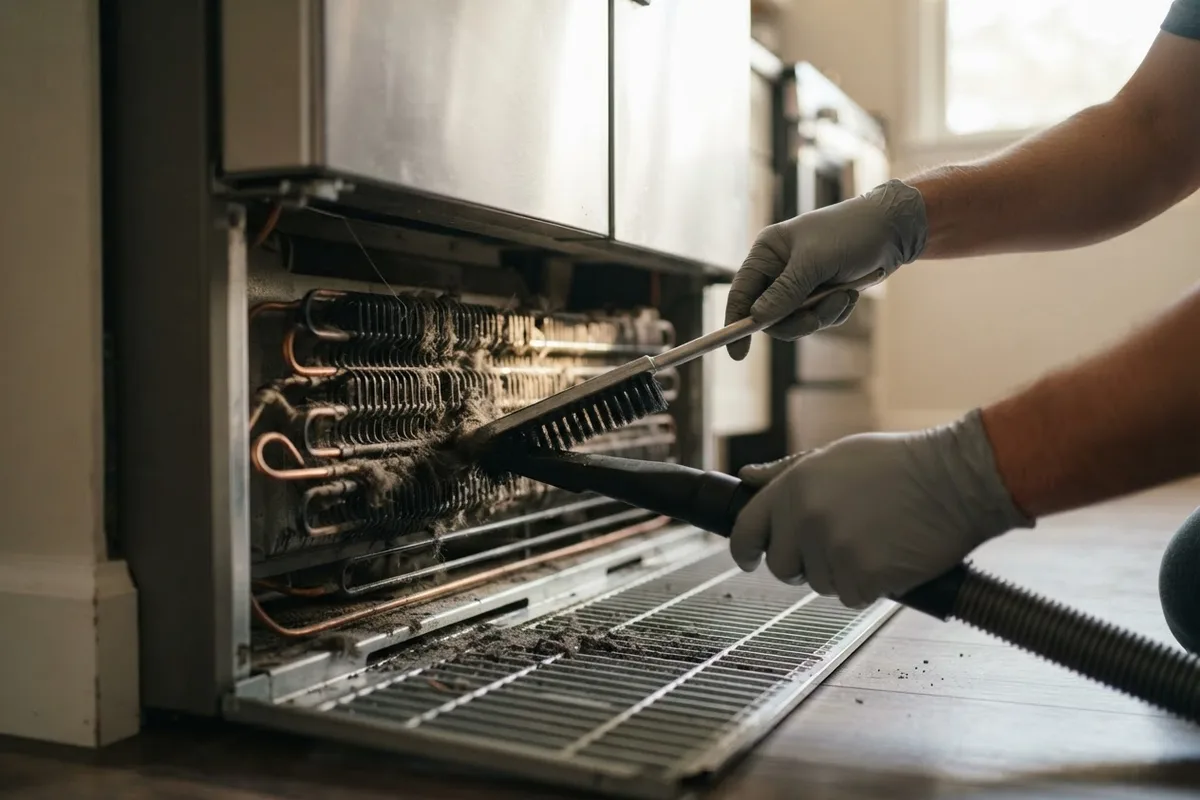
One of the most common reasons a refrigerator stops cooling is dirty condenser coils. The condenser coils are responsible for dissipating heat from the refrigerator as the refrigerant circulates. Over time, these coils, typically located at the bottom behind the base grille or on the back of the unit, collect dust, pet hair, and kitchen grease. When coils are caked in debris, they cannot release heat efficiently, causing the compressor to work harder and the fridge to stop cooling.
To clean your condenser coils, follow these steps:
- Unplug the refrigerator and gently pull it away from the wall to access the bottom or back.
- Remove the base grille at the bottom front or the access panel on the lower back, depending on your model.
- Use a narrow vacuum attachment or a specialized coil brush to gently remove all dust, hair, and lint from the coils. Be careful not to bend or puncture the metal coils.
- Vacuum up any loose dust on the floor around the area.
- Replace the grille or panel, plug the fridge back in, and push it back into place, leaving at least an inch of space between the fridge and the wall for proper airflow.
For a more detailed, step-by-step breakdown of this process, check out our complete guide on how to clean refrigerator coils.
Inspect the Door Gaskets and Seals
Your refrigerator cannot maintain a cold temperature if warm, humid kitchen air is constantly leaking inside. This happens when the rubber door gaskets (seals) become dirty, warped, cracked, or torn. Damaged gaskets force your refrigerator's cooling system to run constantly to compensate for the lost cold air, which can eventually lead to cooling failure and higher energy bills.
- Inspect the rubber gasket all the way around the refrigerator and freezer doors. Look for visible cracks, tears, or spots where the gasket is sagging or pulling away from the door frame.
- Clean the gasket thoroughly with warm water, mild soap, and a soft cloth. Food spills and sticky residue can prevent a proper seal.
- Perform the "dollar bill test." Close the refrigerator door on a dollar bill so that half of it is sticking out. Try to pull the bill out. If it slides out effortlessly, your door seal is too loose and needs to be replaced. Repeat this test along several points of the door.
- If you find damage or a loose seal, you can purchase a replacement gasket specific to your refrigerator model and install it relatively easily by pressing it into the door track.
Clear the Air Vents and Ensure Airflow
Refrigerators rely on internal airflow to keep every shelf at an even, cold temperature. Cold air is typically generated in the freezer compartment and blown into the fresh food compartment through a series of internal air vents. If you pack your refrigerator or freezer too tightly, or if you place large items directly in front of these vents, you can completely block the airflow. This results in a cold freezer but a warm refrigerator compartment.
- Open both your refrigerator and freezer compartments and look for the small, slatted vents along the back or side walls.
- Rearrange your groceries so that no large boxes, milk jugs, or frozen food bags are blocking these vents.
- Ensure there is adequate space between items on every shelf so that air can circulate freely. A good rule of thumb is to keep your fridge about 70% to 80% full. An overly packed fridge restricts airflow, while a completely empty fridge has no thermal mass to help hold the cold. Set a regular schedule to organize your food and keep vents clear.
Test the Evaporator Fan Motor
The evaporator fan motor is responsible for drawing air over the evaporator coils (the cold coils) and circulating that chilled air throughout the refrigerator and freezer compartments. If the evaporator fan motor fails, the freezer may still feel somewhat cold because of its proximity to the coils, but the fresh food compartment will not receive any cold air.
- Listen to your refrigerator while it is running. The evaporator fan is typically located behind the back panel of the freezer. If you hear a squealing, groaning, or chirping noise coming from the freezer, the fan motor may be failing.
- If the fan is not running at all, unplug the refrigerator and remove the freezer's back interior panel to inspect it.
- Check if the fan blade can turn freely by hand. If it is stuck, check for ice buildup that might be blocking it. If it is caked in ice, defrosting your freezer may solve the issue.
- If there is no ice and the blade does not turn easily, or if the motor is getting power but the fan won't spin, the evaporator fan motor likely needs to be replaced. This is a common DIY repair that involves unplugging the old motor and mounting a new one.
Examine the Defrost Timer and System
Modern refrigerators have an automatic defrost system that periodically melts away any frost that accumulates on the evaporator coils. This system includes a defrost timer, a defrost heater, and a defrost thermostat. If the defrost timer fails to advance the fridge into the defrost cycle, frost will continuously build up on the evaporator coils. Eventually, the coils become so choked with ice that airflow is blocked, and the refrigerator will stop cooling entirely.
- If you suspect a defrost issue, unplug your fridge and remove the back wall of the freezer compartment to inspect the evaporator coils. If they are completely encased in a thick block of solid ice or heavy frost, your defrost system is not working.
- Locate your refrigerator's defrost timer. Depending on the model, it may be located behind the bottom front grille, in the control console inside the fridge, or on the back.
- The defrost timer has a small screw or notch that you can turn with a flathead screwdriver. With the refrigerator plugged back in and running, slowly turn the screw clockwise until you hear a distinct, loud click. This click indicates you have manually forced the fridge into the defrost cycle. The fan and compressor should shut off.
- Wait about 10 to 20 minutes. Listen for dripping water or slight hissing noises, which indicate the defrost heater has turned on and is melting the ice.
- If the heater turns on, your defrost timer is likely the culprit and needs to be replaced because it cannot advance automatically. If the heater does not turn on, the issue might be a failed defrost heater or defrost thermostat, which will require further electrical testing with a multimeter.
Quick-Reference Troubleshooting Table
| Symptom | Potential Cause | Recommended DIY Fix |
|---|---|---|
| Fridge warm, freezer cold | Blocked air vents | Rearrange food; clear vents |
| Fridge warm, freezer cold | Failed evaporator fan | Check fan blade; replace motor |
| Entire fridge is warm | Dirty condenser coils | Vacuum and brush coils |
| Entire fridge is warm | Incorrect thermostat setting | Adjust thermostat to 37°F-40°F |
| Entire fridge is warm | Damaged door gaskets | Clean gasket; replace if torn |
| Ice buildup in freezer | Defrost system failure | Manually advance defrost timer |
When to Call a Pro
While many refrigerator issues can be solved with these 6 easy DIY fixes, some problems require advanced tools and diagnostic skills. If you have thoroughly cleaned the condenser coils, checked the door seals, cleared the vents, and ensured the thermostat is correct, but your refrigerator is still not cooling, it is time to seek professional help.
You should always stop and call a professional technician if you suspect a sealed-system issue. Symptoms of sealed-system failures include a compressor that runs continuously but produces no cold air, a completely warm fridge accompanied by a strong chemical smell, or visible oil residue near the compressor. Additionally, if your diagnostic tests point toward a failed compressor, a refrigerant leak, or complex control board failures, these require specialized equipment to fix safely.
If you determine that your fridge requires a professional touch, or if you are simply unsure about performing any of the steps above, True Appliance Repair can match you with a local appliance pro. An experienced technician can quickly diagnose the issue, provide a reliable fix, and help you determine whether a repair makes sense or if your refrigerator is dying and needs replacement. Refrigerator repair costs generally vary significantly by area and model, but a local expert can provide an accurate estimate. Visit our refrigerator repair services page to connect with a trusted local professional today.
FAQ
How long does it take for a refrigerator to get cold after fixing it?
After you have successfully fixed the underlying issue, it typically takes 12 to 24 hours for a refrigerator to completely cool down and stabilize at the correct temperature (37°F to 40°F for the fridge, and 0°F for the freezer). Avoid opening the doors frequently during this initial cooling period, and wait until the fridge reaches a safe temperature before restocking it with perishable groceries.
Can dirty condenser coils really stop a fridge from cooling?
Yes, absolutely. Dirty condenser coils are one of the most common causes of a refrigerator not cooling properly. When the coils under or behind the fridge are covered in dust, pet hair, and debris, they cannot dissipate heat efficiently. This causes the compressor to overheat and run longer cycles, which ultimately reduces the cooling capacity of the refrigerator and can even lead to premature compressor failure.
Why is my refrigerator warm but the freezer is still freezing?
If your freezer is working perfectly but your refrigerator compartment is warm, the issue is almost always related to airflow. In most refrigerators, cold air is generated in the freezer and then blown into the fresh food compartment via a fan and internal vents. If your refrigerator is warm but the freezer is cold, you likely have blocked air vents due to misplaced groceries, a failed evaporator fan motor that is not pushing air into the fridge, or a failing defrost system causing ice to block the vents. Check your vents and evaporator fan first.
How do I know if my refrigerator compressor is bad?
A refrigerator compressor is the heart of the cooling system. If it goes bad, your fridge will completely stop cooling. Tell-tale signs of a bad compressor include a continuous, loud clicking or buzzing sound coming from the bottom back of the fridge, a compressor that feels extremely hot to the touch but does not produce cold air, or a compressor that simply does not turn on at all while the interior lights remain functional. If you suspect a compressor failure, you should immediately unplug the unit and contact a professional, as compressor replacements involve working with the sealed refrigerant system.