
You turn your stove dial down to simmer a pot of soup or holiday gravy, only to watch it boil over and scorch the bottom of the pan. A stove burner staying on high no matter where you set the knob wastes energy, ruins meals, and can damage your cookware fast. Most of the time, the culprit is a worn control switch, a damaged heating element, or a loose knob, and a few safe checks will help you pinpoint it quickly.
1. Turn Off Power at the Breaker First
Before touching a burner element, drip pan, or control knob shaft, cut electrical power to your range completely. Electric stoves run on 240-volt circuits that carry dangerous current even when every knob sits in the off position.
- Open your home's main electrical panel and locate the double-pole breaker labeled "Range," "Stove," or "Oven."
- Flip that breaker firmly to the OFF position, or unplug the range cord if it is safely accessible.
- Return to the kitchen and test the oven light or digital clock to verify power is completely off.
- Let the cooktop and any coil elements cool for at least 30 minutes before handling them.
Never rely on the control knob alone when checking sockets or terminals. If you cook on a gas range and are dealing with erratic flames rather than an electric burner, check our guide on why a gas stove flame turns yellow or orange for gas-specific safety steps.
2. Check the Control Knob and Shaft
Sometimes the burner itself regulates heat fine, and the problem is simply a stripped or misaligned knob spinning loosely on the metal stem. When the plastic sleeve inside a knob cracks, turning the dial to Low can leave the internal switch parked on High.
- Pull the affected control knob straight off its metal stem without prying against the panel.
- Inspect the back of the knob for cracks around the plastic D-ring insert or a missing metal tension clip.
- Check which direction the flat side of the metal stem points when the burner feels stuck on full heat.
- Wipe sticky cooking grease off the stem and knob backing with a damp microfiber cloth and mild dish soap, then dry thoroughly.
If the plastic insert looks split or rounded out, swap the knob temporarily with an identical knob from a working burner after turning power back on to test whether control returns. Replacement knobs snap on in seconds and cost very little.
3. Inspect Coil Burner Prongs and Sockets
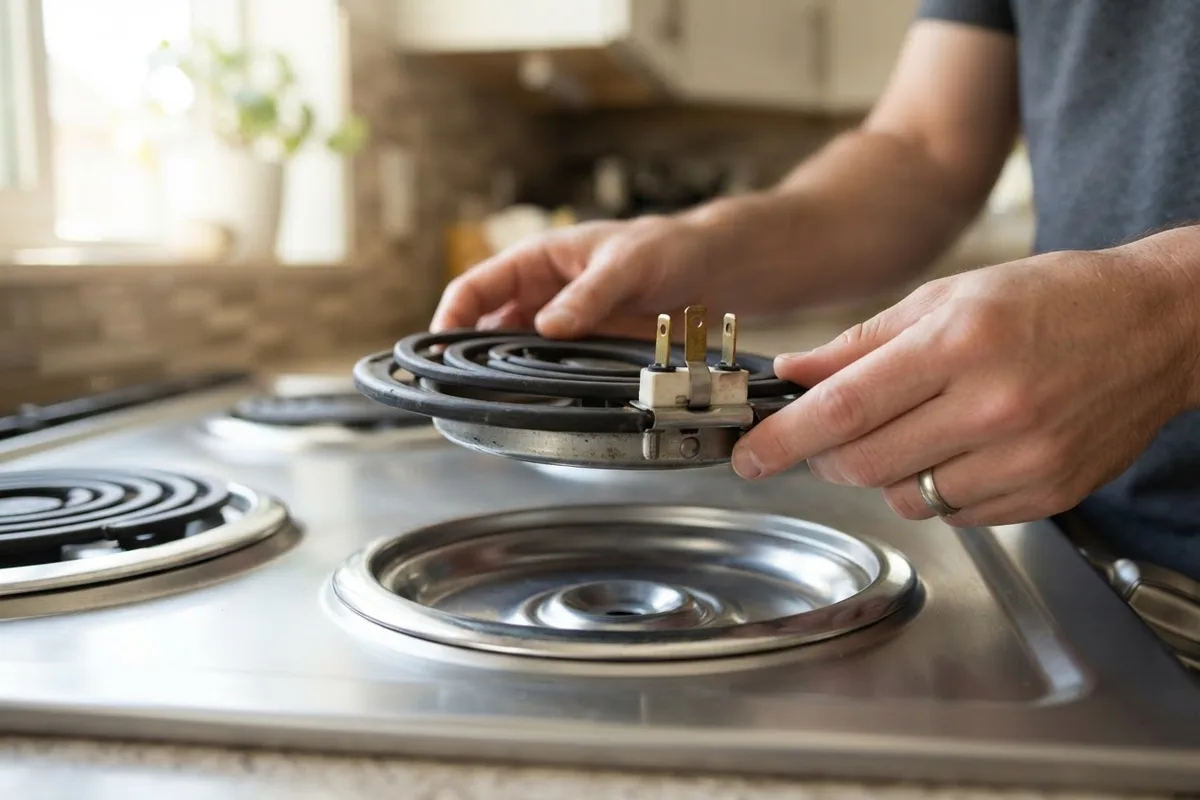
On traditional electric coil stoves, dirty terminal prongs or a worn receptacle block can create poor electrical contact, arcing, or erratic heating. Checking the plug-in element connection takes just a few minutes once the range is cool and powered off.
- Lift the outer edge of the cool coil element slightly and pull it straight out of the terminal socket.
- Examine the two flat metal prongs at the end of the coil for black burn marks, pitting, or melted metal.
- Look inside the porcelain terminal block under the drip pan for scorch marks, loose wires, or built-up grease.
- Check the coil surface for blisters, cracks, or sagging spots that signal internal element damage.
If the prongs look clean and intact, push the coil firmly back into the socket until it rests flat in the drip pan. Any visible charring, melted insulation, or bubbling on the coil means the element or terminal block should be replaced before you use that burner again.
4. Watch How the Burner Cycles on Low
Knowing how electric burners regulate heat helps you tell normal operation apart from a broken part. Unlike gas flames that shrink steadily as you lower the dial, both exposed coils and smooth glass-top radiant burners hold lower temperatures by pulsing full power on and off.
- Restore power at the breaker and turn the cool burner to Low (or setting 2 out of 10) without a pot covering the ring.
- Watch the burner from a safe distance for three to four full minutes without touching the dial.
- On a properly working burner, the coil or radiant ring should glow bright orange-red briefly, click off completely for 20 to 40 seconds, and repeat.
- Note if a dual-ring glass-top element keeps both its inner and outer coils glowing continuously.
If the element stays glowing nonstop for several minutes without cycling off, the control circuit is feeding uninterrupted voltage to the burner. That points directly toward a stuck switch or wiring fault.
5. Spot Signs of a Bad Infinite Switch
Behind each knob sits an infinite switch—the small regulating box that opens and closes internal contacts to cycle power to the burner. Over years of cooking heat and spills, those internal metal contacts can weld together, locking the burner at full output no matter where you turn the dial. On glass-top stoves, a built-in limiter thermostat inside the radiant element can also fail in a similar way.
- Listen closely near the control panel while turning the knob slowly from Off toward Low and High.
- Notice if the dial turns with zero resistance or skips the subtle click it should make when leaving Off.
- Watch for a burner that stays hot even after you turn the dial completely to Off.
| Symptom You Notice | Most Likely Cause | Safe Next Step |
|---|---|---|
| Knob spins freely or feels loose | Cracked knob insert | Replace plastic control knob |
| Scorch marks on coil prongs | Burned terminal block or coil | Keep breaker off; replace part |
| Burner never cycles off on Low | Welded infinite switch contacts | Have switch tested and replaced |
| Heat stays on when knob is Off | Shorted switch or wiring fault | Shut off breaker; call a pro |
When to Call a Pro
You can safely replace a cracked knob, clean grease off a drip pan, or swap out a damaged plug-in coil element yourself with the breaker off. Stop and call a technician whenever a burner stays hot in the Off position, never cycles down on Low, trips your breaker, or produces a burning plastic smell behind the backsplash.
Testing and replacing an infinite switch, glass-top radiant element, or charred internal wiring requires opening the stove chassis, checking 240-volt continuity safely, and installing exact model-matched parts. Across the US, having a technician diagnose and replace a faulty infinite switch typically runs around $120 to $260 total, though pricing varies by area and stove model. If your oven is acting up at the same time—such as a broiler that stopped working—mention both symptoms so everything gets checked together. When you need hands-on help, True Appliance Repair can connect you with an independent local pro for oven and stove repair.
FAQ
Why does my glass-top stove burner glow red even on low?
Glass-top radiant burners regulate heat by cycling on at full brightness and then shutting off for short intervals. Seeing the element glow bright red for 10 to 20 seconds on low is normal as long as it turns dark again between cycles. If it stays glowing nonstop for several minutes and boils food over, the infinite switch has likely failed.
Can a dirty stove knob make a burner stay on high?
Grease buildup alone usually makes a knob feel stiff rather than stuck on high, though thick residue can stop a knob from seating fully onto its stem. Cleaning the metal shaft and inspecting the inner plastic D-ring is an easy first step. If the plastic sleeve inside the knob is stripped, the dial will spin without turning down the switch.
Is it safe to cook on a stove burner that won't turn down?
No, cooking on a burner stuck on high creates a burn and grease-fire risk, especially when simmering sauces or heating oil. Sustained overheating can also warp cookware and crack a ceramic glass cooktop. Leave that burner unused—or turn off the range breaker if it refuses to shut off—until it is repaired.
How much does it cost to fix an electric stove infinite switch?
Most homeowners pay roughly $120 to $260 for parts and labor combined, though exact pricing varies by area, range brand, and whether a radiant element also needs replacement. Because infinite switches sit right behind the control panel, a technician can usually complete the swap in a single visit.