
Hearing a loud, metallic bang coming from the laundry room can make any homeowner sprint to hit the pause button. Whether your washing machine is slamming against its cabinet during a high-speed spin or making a sharp thud in the walls when the water shuts off, that racket is a clear sign something is out of alignment. By matching the exact moment the bang happens to the six practical checks below, you can quiet down your machine and prevent expensive drum or plumbing damage.
Safety First: Before inspecting internal components, tilting the cabinet, or reaching beneath your appliance, always unplug the washing machine from the wall outlet and turn off both the hot and cold water supply valves.
1. Redistribute Heavy or Tangled Laundry Loads
The most common culprit behind a washer making a bang noise during the spin cycle is a severely unbalanced load. When heavy items like winter blankets, bath mats, or denim jeans ball up on one side of the drum, centrifugal force sends the inner basket slamming against the outer tub housing.
- Press pause and wait for the drum and door lock to release completely.
- Open the door or lid and untangle any sheets or towels that have wrapped around smaller clothing items.
- If you are washing a single bulky item like a rug or pillow, add two or three bath towels to counterbalance the weight on the opposite side of the drum.
- Avoid stuffing the drum past three-quarters full; laundry needs room to tumble freely so the washer can distribute weight evenly before ramping up to high speed.
- Run a ”Drain and Spin” cycle to verify that the basket now accelerates smoothly without hitting the cabinet walls.
2. Level the Legs and Lock the Jam Nuts
Even a perfectly balanced load will cause a violent banging sound if the washing machine itself is sitting unevenly on the laundry room floor. When one corner is even a quarter-inch lower than the others, the entire cabinet rocks and slams against the floor as the drum spins.
- Unplug the washer and place a carpenter’s bubble level across the top of the cabinet from front to back, and then from side to side.
- Push down firmly on opposite diagonal corners of the machine to feel for any rocking motion.
- Locate the threaded leveling legs under the front corners (and rear corners on some models). Use an adjustable wrench to turn the legs clockwise to lower the corner, or counterclockwise to raise it.
- Once the bubble is centered in both directions and all four rubber feet sit flat on the floor, tighten the metal locking nut (jam nut) firmly up against the bottom of the washer base so vibrations cannot loosen the leg again.
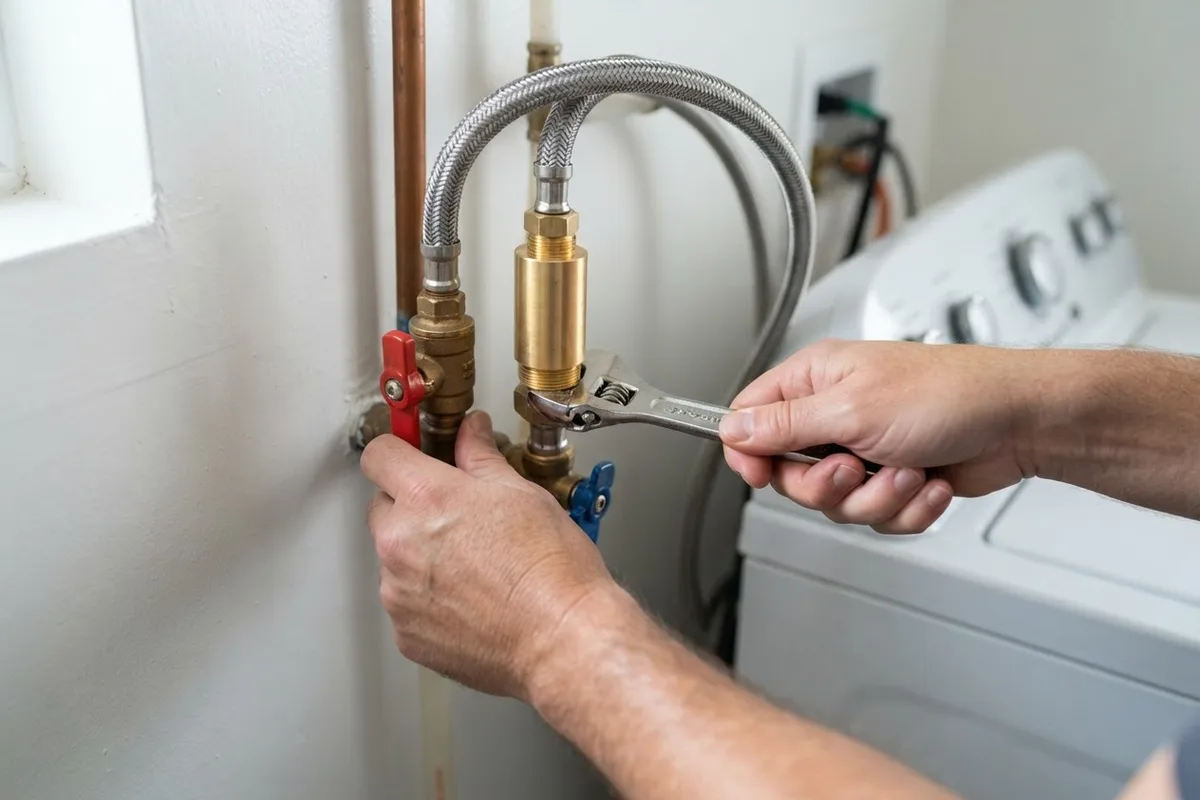
3. Install Water Hammer Arrestors on Inlet Valves
If your washer makes a single, sharp ”bang” inside the wall right as the tub finishes filling with water, the drum is not the problem at all. You are hearing ”water hammer”—a hydraulic shockwave that happens when the washer’s electronic inlet valve snaps shut instantly, causing fast-moving water in your home's pipes to slam to a dead stop.
- Turn off both the hot and cold water supply shutoff valves behind the washer.
- Place a bucket and old towel under the valves, then unscrew the hot and cold rubber or braided steel supply hoses from the wall faucets.
- Inspect the rubber washers inside the hose fittings and replace them if they look flattened or brittle.
- Screw a residential mini water hammer arrestor (available at any hardware store for $12 to $25 each) directly onto the threads of both the hot and cold wall faucets.
- Reattach your washer supply hoses onto the bottom of the arrestors, tighten them snugly with pliers without over-tightening, and slowly turn the water back on while checking for drips.
4. Replace Stretched Suspension Rods (Top-Loaders)
Top-load washing machines hang their wash tub from four long metal suspension rods equipped with heavy springs and friction dampers at the base. Over years of heavy loads, those springs lose tension or a plastic damper cup cracks, allowing the heavy tub to bounce wildly and bang against the steel cabinet.
- Unplug the machine and shut off the water valves. Open the lid and push straight down on the center of the wash basket by several inches, then let go abruptly.
- A healthy tub will rise back up once and stop immediately. If the tub bounces up and down multiple times like a pogo stick, or if one corner sits noticeably lower than the others, the suspension rods are worn out.
- Remove the two rear hinge screws on the control console or top panel (depending on your model), tilt the top lid assembly back, and tape it securely out of the way.
- Disconnect one old rod at a time from its plastic bracket at the top corner of the frame, unhook it from the bottom of the outer tub, and slide the replacement rod into place using the lithium grease packet included with the kit.
- Always replace all four rods as a complete set so the tub hangs evenly.
5. Swap Out Worn Shock Absorbers (Front-Loaders)
Instead of hanging from vertical rods, a front-load washer rests its heavy outer drum on two to four hydraulic shock absorbers bolted to the bottom base frame. Just like car shocks, these dampers wear out or leak fluid over time, causing a loud metallic knocking or banging noise when the drum decelerates from a high-speed spin.
- Unplug the washer, turn off the water supply, and remove the lower front access kickplate or rear access panel using a nut driver or Phillips screwdriver.
- Locate the black or gray cylinder shock absorbers connecting the bottom of the outer plastic tub to the metal floor frame of the washer.
- Inspect the shocks for cracked plastic housings, bent metal shafts, or dark greasy residue leaking onto the base frame.
- To test a shock, unbolt its lower mounting pin (or squeeze the locking tab and twist it 90 degrees on twist-lock models) and push the piston in and out by hand. It should require strong, steady force to move; if it slides effortlessly with zero resistance, replace all shocks on the machine.
6. Tighten a Loose Counterweight or Drive Pulley
Front-load washers use massive concrete blocks bolted directly to the front and back of the outer tub to keep the drum steady during 1,200-RPM spins. If the mounting bolts holding these counterweights—or the central nut holding the rear drive pulley wheel—vibrate loose, you will hear a terrifying, rhythmic hammering noise every time the drum turns.
- With the power cord unplugged and the rear access panel removed, inspect the large drive wheel (or flat rotor on direct-drive models) bolted to the center of the rear tub.
- Grab the edges of the pulley wheel and wiggle it back and forth. If it clanks or has play on the shaft, apply a drop of removable thread-locking compound to the central bolt threads and tighten it firmly with a socket wrench.
- Check the concrete counterweight blocks mounted around the outer tub for cracks or chalky dust underneath them.
- Use a socket wrench to tighten each counterweight mounting bolt until snug, being careful not to over-torque and crack the concrete block.
- While you have the laundry area open, consider giving the tub a refresh—check out our guide on how to clean a top-load washing machine to remove hidden soap scum that can throw the basket off balance.
Quick Reference: Washer Bang Noise Diagnostic Table
| When the Bang Happens | What It Sounds Like | Most Likely Cause | Typical DIY Part Cost* |
|---|---|---|---|
| Start or end of water fill | Sharp single thud inside the wall pipes | Water hammer from fast-closing valves | $25–$50 (pair of arrestors) |
| Mid-spin with heavy towels | Irregular, heavy thudding against side panels | Unbalanced load or unlevel feet | $0 (redistribute & level) |
| Every spin cycle (top-loader) | Tub slamming cabinet; bounces when pushed | Weak or broken suspension rods | $40–$90 (set of 4 rods) |
| High-speed spin (front-loader) | Loud bottoming-out clunk as drum slows | Worn-out hydraulic shock absorbers | $50–$110 (set of shocks) |
| Every rotation, even by hand | Rhythmic heavy knocking inside cabinet | Loose concrete counterweight or pulley | $0–$60 (tighten or replace) |
Note: Part prices are broad typical US ranges and vary by area, brand, and model.
When to Call a Pro
Most washer banging noises come down to load balance, leveling, water hammer, or straightforward suspension parts that a careful DIYer can tackle in an afternoon. However, you should stop and call an appliance professional if you spin the empty inner drum by hand and feel a rough, gravelly rumble accompanied by up-and-down play between the inner basket and outer tub. That points to a cracked rear spider arm or a failed rear tub bearing—a major tear-down job that requires hoisting the entire drum assembly out of the cabinet. Similarly, if your companion dryer is also acting up, see our guide on why a dryer makes a humming noise before scheduling service.
Professional suspension or drive repairs typically run between $180 and $400 depending on your model and local labor rates, while a full rear bearing and spider arm replacement can run $450 to $650+ (varies by area and model). If you would rather skip the heavy lifting, True Appliance Repair can connect you with an independent local technician through our washer and dryer repair service page.
FAQ
Is it safe to keep running my washing machine if it is making a loud bang?
No. Running a washing machine that is actively banging can crack the outer plastic wash tub, snap a concrete counterweight, or burst a supply hose from excessive vibration. Pause the cycle immediately, redistribute the laundry, and inspect the leveling feet and suspension before running another load.
Why does my washer bang loudly when the water stops filling?
That noise is called water hammer. Modern washers use fast-acting electric solenoid valves that shut off water flow in a fraction of a second, causing the rushing water in your home's copper or PEX pipes to slam against the closed valve. Installing screw-on water hammer arrestors at the wall faucets absorbs that pressure wave and stops the bang.
How do I know if my top-load washer needs new suspension rods?
Open the lid on an empty, unplugged washer and push the center of the wash tub straight down toward the floor by three to four inches, then release it quickly. If the tub springs back into place and stops immediately, the rods are fine; if it bounces up and down more than once or leans noticeably toward one corner, the suspension rods need to be replaced.
Can too much detergent cause a washer to bang during the spin cycle?
Surprisingly, yes. Using too much detergent—or non-HE detergent in a high-efficiency machine—creates thick cushions of excess suds between the inner basket and outer tub. This ”suds lock” drags on the spinning drum, tricks the balance sensors, and causes the washer to lurch and bang as it struggles to drain and spin.