
Nothing ruins a quiet afternoon faster than the loud thudding of a washing machine migrating across your laundry room mid-spin. When a washer starts "walking," the violent momentum can strain water supply hoses, scratch flooring, and damage internal components. Fortunately, most cases of a wandering washer come down to simple leveling, floor grip, or load balance issues you can resolve yourself in under an hour.
Safety First: Before inspecting underneath or behind your washing machine, always unplug the power cord from the wall outlet and turn off both hot and cold water supply valves. Never reach under a tilted appliance without stable support.
1. Level the Front and Rear Washer Legs
An unlevel cabinet is the number one reason a washing machine walks across the floor. Even a quarter-inch tilt causes the spinning drum to throw its weight unevenly toward the lowest corner, turning a normal spin cycle into a lurching march.
- Unplug the washer and place a carpenter's bubble level across the top front edge, then from front to back on both sides.
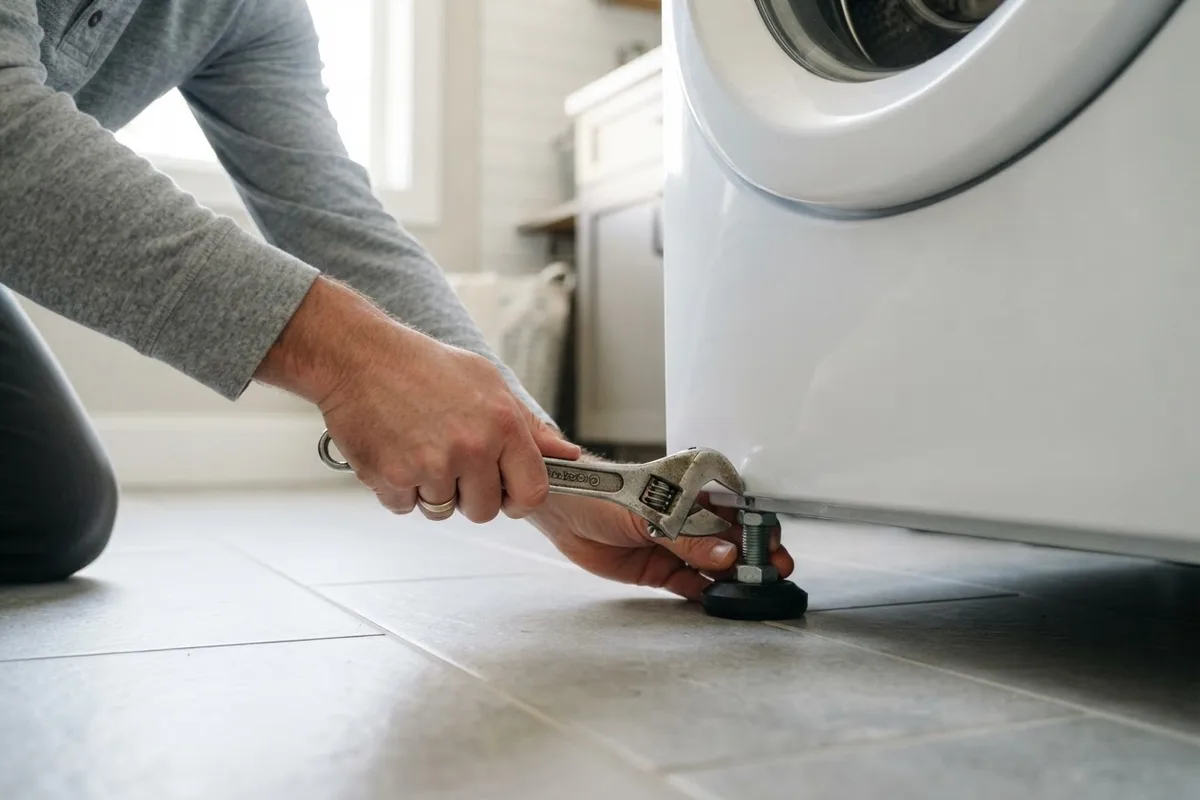
- Locate the threaded leveling legs at the bottom corners of the machine.
- Loosen the locking nut on any low leg using an adjustable wrench or channel-lock pliers.
- Turn the foot clockwise to lower the corner (raising the machine) or counterclockwise to lower the machine until the bubble sits centered.
- Tighten the locking nut firmly against the base of the washer cabinet so vibrations cannot loosen the leg again.
- Push down diagonally on opposite corners of the top panel; if there is any rocking at all, fine-tune the feet until all four pads sit planted.
2. Clean the Rubber Feet and Laundry Floor
Even a perfectly level washing machine will slide if its rubber feet cannot grip the floor. Over time, spilled liquid detergent, fabric softener mist, and dryer sheet residue create an invisible, slick film on tile, vinyl, and sealed concrete floors. While you are tidying up detergent spills around the cabinet, it is also a smart time to check if your washer bleach dispenser is not working due to similar buildup.
- Mix warm water with a few drops of grease-cutting dish soap and a splash of white vinegar.
- Scrub the floor directly beneath and around all four washer feet, then wipe dry with a clean towel.
- Tip the unplugged machine slightly backward (with a helper) and scrub the bottom of each rubber foot pad to remove hardened lint and soap scum.
- Check that the rubber pads on the feet are not cracked, missing, or worn down to bare metal. Replacement rubber foot pads typically cost $10 to $25 for a set of four (varies by model) and thread right onto the existing legs.
3. Remove Forgotten Transit Bolts on Newer Units
If your front-load washer was recently installed or moved to a new home and immediately started jumping across the room on its first spin cycle, the shipping bolts are almost certainly still in place. Manufacturers bolt the heavy inner drum rigid to the back of the cabinet to prevent suspension damage during delivery. With those bolts left in, the shock absorbers cannot absorb a single rotation.
- Pull the unplugged washer away from the wall so you can see the rear metal panel.
- Look for three or four large metal bolts—often highlighted with bright plastic spacers—arranged in a pattern around the center of the back panel.
- Use a socket wrench or the wrench included with your owner's manual to unthread and remove every bolt.
- Pull out the long plastic spacers attached to the bolts and snap the provided plastic hole covers into the open slots.
- Save the bolts and spacers in a labeled bag in case you move in the future.
4. Balance Heavy Winter Bedding and Towels
As cooler weather arrives and households wash heavy comforters, flannel sheets, and thick bath rugs, out-of-balance loads spike. A single waterlogged bath mat or a tangled duvet cover presses against one side of the drum, creating massive centrifugal force at 1,000+ RPM.
- Avoid washing a single heavy item by itself; pair one heavy bath rug with two or three medium towels so weight distributes around the entire cylinder.
- Shake out sheets and blankets before loading rather than stuffing them in folded or balled up.
- Fill the drum only about two-thirds to three-quarters full so items have room to tumble and redistribute before the high-speed spin begins.
- If your washer stops or starts pounding mid-cycle, pause the machine, wait for the door lock to release, and manually untangle the wet laundry.
- Select a lower spin speed setting (Medium instead of High) when washing bulky, water-absorbent bedding.
5. Install Anti-Vibration Pads or a Plywood Base
Upstairs laundry rooms built over wood floor joists naturally flex more than concrete basement slabs. That slight trampoline effect amplifies drum movement until the washer creeps forward with every load.
- Purchase a set of dense, heavy-duty rubber anti-vibration pads (typically $15 to $35 at hardware stores, varies by brand).
- Avoid soft foam pads, which compress unevenly over time and actually worsen rocking.
- Center one solid rubber cup pad directly under each leveled foot.
- If your laundry room subfloor has noticeable bounce or damaged vinyl tiles, cut a piece of 3/4-inch exterior-grade plywood slightly larger than the washer footprint, screw it down into the floor joists (avoiding pipes and wiring), and set the washer on top.
- Keep at least 1 to 2 inches of clearance between the washer and your dryer so a slight vibration does not cause the cabinets to bang together.
6. Inspect Suspension Rods or Shock Absorbers
When leveling, floor prep, and balanced loads do not stop your washer from walking across the floor, the internal suspension system is likely worn out. Top-load washers hang the tub from four suspension rods and springs, while front-load washers anchor the tub from below with hydraulic shock absorbers.
- Unplug the washer and open the lid or door.
- Push the empty inner drum down firmly by hand about two to three inches, then release it suddenly.
- Watch how the drum recovers: a healthy suspension snaps straight back to center and stops immediately.
- If the drum bounces up and down several times like a pogo stick, moves with almost no resistance, or makes a loud clunking noise, one or more shock absorbers or suspension rods have failed.
- While you have the laundry area open for inspection, listen to your dryer too—if you hear unusual sounds there, check our guide on why your dryer is making a scraping noise.
Quick Reference: Why Is Your Washer Walking?
| Symptom | Most Likely Cause | Typical DIY or Repair Cost* |
|---|---|---|
| Walks on every load, rocks when pushed by hand | Unlevel legs or unlocked jam nuts | $0 (requires a wrench and level) |
| Slides smoothly across tile or vinyl | Soap film on floor or worn rubber feet | $0–$25 for cleaner or new foot pads |
| Jumps violently right after installation or moving | Shipping bolts still installed in back | $0 (remove with socket wrench) |
| Walks only when washing rugs, jeans, or bedding | Out-of-balance load or wrong spin setting | $0 (redistribute laundry) |
| Bounces repeatedly when empty drum is pushed down | Worn shock absorbers or suspension rods | $50–$150 DIY parts / $180–$350 pro repair |
Costs are broad US estimates and vary by area, appliance brand, and model.
When to Call a Pro
Adjusting leveling feet, cleaning slick floors, and installing anti-vibration pads are safe, straightforward weekend tasks. However, if the drum-push test reveals broken suspension springs, detached dampers, or a cracked outer tub counterweight, disassembly gets heavy and complex quickly. Replacing front-load shock absorbers requires tipping or opening the cabinet and maneuvering around tight wiring harnesses and sharp sheet metal.
If your washing machine still walks after you level and balance it, stop running high-speed spin cycles to avoid rupturing a water supply line or cracking the drain pump. True Appliance Repair can match you with an independent local specialist for professional washer and dryer repair to safely swap worn suspension parts and get your laundry room quiet again.
FAQ
Can a walking washing machine damage my plumbing?
Yes. If a washing machine walks far enough forward, it pulls tight on the hot and cold rubber fill hoses and can yank the drain hose right out of the wall standpipe. Upgrading to braided stainless steel fill hoses of adequate length gives you extra protection against sudden leaks.
Do anti-vibration washer pads actually work?
High-density rubber pads help absorb high-frequency hum and prevent smooth feet from sliding on slick tile or hardwood floors. However, pads will not fix an unlevel machine or worn-out internal shock absorbers—you must level the washer legs first for pads to be effective.
Why does my front-load washer walk more than my old top-loader?
Front-load washers spin much faster (often 1,100 to 1,300 RPM compared to 600 to 800 RPM on older top-loaders) to extract more water and shorten drying times. Because the drum sits horizontally, any heavy wet item clinging to one side pushes outward and side-to-side rather than just against the bottom.
How much does it cost to fix washer shock absorbers or suspension rods?
Buying a set of four suspension rods or shock absorbers yourself typically runs $50 to $150 depending on the brand and model. Having a local appliance technician supply the parts and complete the repair generally ranges from $180 to $350, though exact pricing varies by area and machine design.