
Opening your washer at the end of a cycle only to find a heavy pile of sopping-wet clothes sitting in the drum brings laundry day to a halt. In most cases, a washing machine skips or slows its final spin because a safety sensor detected an off-balance load, an unlatched lid, or water that failed to pump out fast enough. By working through the six practical checks below, you can often get your washer spinning at full speed again without waiting for a service call.
Safety First: Before inspecting underneath the cabinet, clearing the drain pump filter, or testing any switches, always unplug your washing machine from the wall outlet (or switch off the dedicated circuit breaker) and turn off both hot and cold water supply valves.
1. Rebalance an Uneven or Overloaded Drum
Modern top-load and front-load washers have sensitive electronic vibration sensors. If heavy items like wet bath mats, jeans, or bedding clump together on one side of the wash basket, the control board automatically cancels or slows the high-speed spin to keep the drum from banging violently against the cabinet.
- Open the washer door or lid and check if heavy fabrics are tangled into a tight ball on one side of the drum.
- Untangle sheets, towels, and trousers, then redistribute them evenly around the outer perimeter of the wash basket.
- If you are washing a single bulky item like a small rug or pillow, add two dry bath towels to counterbalance the weight.
- If the drum is packed tightly to the top, remove a third of the wet clothes and wring them out into a laundry basket so the washer can spin the load in two smaller batches.
- Close the door and select the standalone "Drain & Spin" or "Spin Only" cycle to test whether the drum reaches full speed.
2. Level the Washing Machine Feet
Even a well-balanced laundry load will trigger the out-of-balance sensor if the washing machine itself sits crooked on the laundry room floor. When one front corner is slightly lower than the others, the spinning basket wobbles early in the ramp-up phase and aborts the spin cycle.
- Place a carpenter's bubble level across the top front edge of the washer, and then front-to-back along both sides.
- Push down firmly on opposite diagonal corners of the cabinet; if the machine rocks at all, at least one leveling leg is out of adjustment.
- Unplug the washer and have a helper tilt the cabinet slightly backward so you can access the threaded front leveling feet underneath.
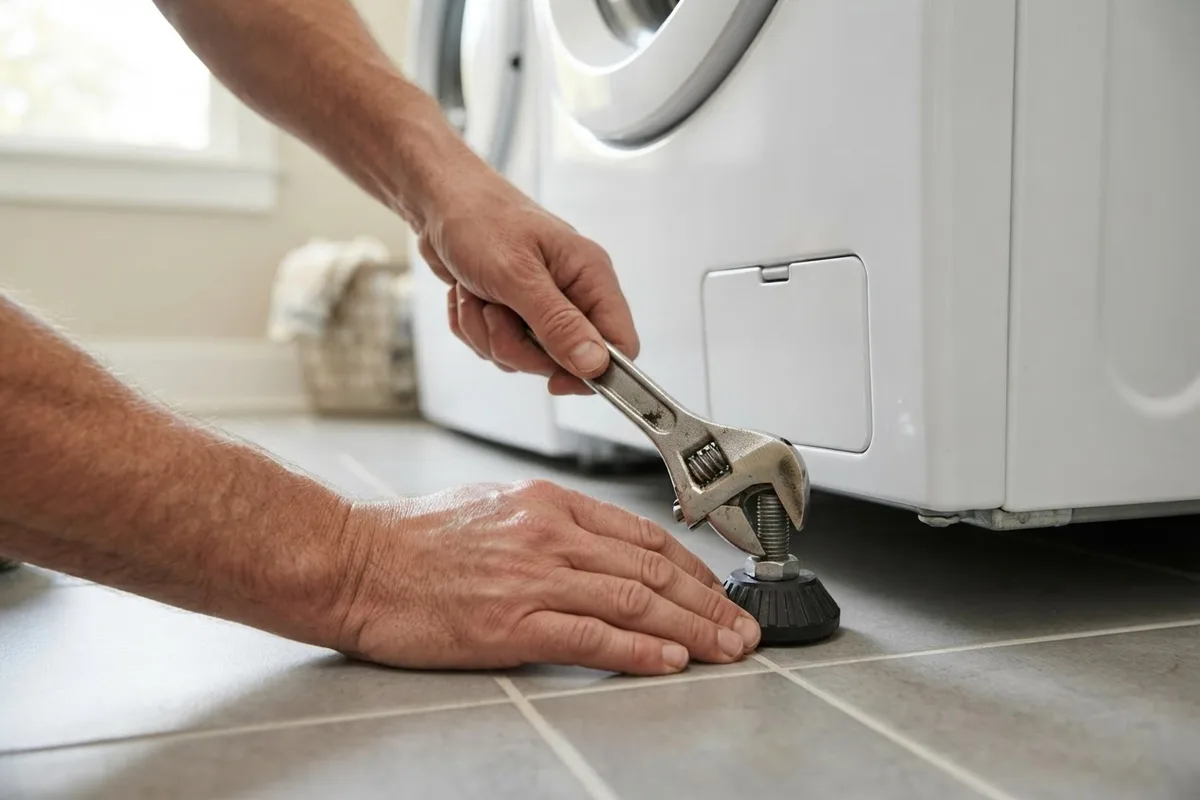
- Use an adjustable wrench or channel-lock pliers to turn the lower foot counterclockwise to extend it, or clockwise to shorten it, until the bubble is centered.
- Once all four rubber feet sit flat and firm against the floor with zero rocking, tighten the metal lock nut on each leg up against the bottom of the washer base so vibrations cannot loosen them.
3. Clear the Drain Pump Coin Trap
A washing machine will never enter its high-speed spin cycle if water is still sitting in the bottom of the tub. If hairpins, socks, coins, or lint block the drain pump filter, the water drains too slowly, the cycle timer runs out, and the machine stops with wet clothes inside.
- Unplug the washer and locate the small rectangular or round pump access door on the lower front panel (common on front-loaders and some high-efficiency top-loaders).
- Lay a thick folded bath towel and a shallow baking dish on the floor directly beneath the access panel to catch trapped water.
- Unclip the small black rubber drain hose next to the filter cap, hold its tip over your dish, and pull the plug out until water stops trickling.
- Slowly turn the large round filter knob counterclockwise and pull the plastic strainer screen out of the housing.
- Remove any coins, buttons, hair clumps, or baby socks from the filter and reach carefully into the pump cavity (with the power unplugged) to make sure the small plastic pump impeller blades can turn freely.
- Rinse the filter under warm water, thread it securely back into place, and run a "Drain & Spin" cycle.
4. Straighten a Kinked Rear Drain Hose
Sometimes the drain pump is completely clean, but water cannot leave the drum fast enough because the corrugated flexible drain hose behind the washer is pinched against the wall or clogged where it meets the household standpipe.
- With the machine unplugged, slide it six to eight inches forward from the wall so you can see the flexible gray or black drain hose.
- Check the entire length of the hose for sharp bends, flattened spots, or kinks caused by pushing the washer too close to the wall.
- Inspect where the hose enters the vertical wall standpipe; make sure it extends only 4 to 6 inches down into the pipe and is not sealed airtight with duct tape, which causes airlocks and back-siphoning.
- If the hose feels heavy or blocked, close the water valves, place a bucket underneath, loosen the hose clamp at the back of the washer, and flush the hose outside with a garden hose.
- Reattach the hose securely and leave at least four inches of clearance behind the washer when sliding it back into place.
5. Check the Lid Switch or Door Lock Strike
As a critical safety feature, no washing machine will spin unless its electronic lock confirms the door or top lid is securely shut. If the plastic strike tab is cracked, or if detergent residue gums up the latch catch, the washer will agitate and drain normally but refuse to spin.
- Unplug the washer and inspect the plastic or metal strike prong attached to the underside of the top lid or the inner rim of the front door.
- If the strike is loose, tighten its mounting screws; if the plastic hook is cracked or bent, order an exact model replacement strike (usually a $10 to $25 part).
- Dip a cotton swab in rubbing alcohol and clean out any hardened detergent or lint inside the latch slot on the washer frame.
- On older top-load washers, press down gently inside the lid switch slot with the blunt end of a wooden clothespin; you should hear a crisp, audible click. If there is no click or the switch housing feels loose, the lid switch assembly has likely failed.
- Close the lid firmly and check whether the "Lid Locked" indicator light illuminates steadily on the control panel when starting a spin cycle.
6. Reset the Master Control Board
Occasionally a power surge, a brief utility flicker, or a mid-cycle pause causes the washer's electronic control board to freeze right before the spin sequence. Performing a hard power reset clears temporary error codes from the memory.
- Press the power button to turn the display off.
- Unplug the washing machine power cord from the wall outlet (or flip the laundry circuit breaker completely off at your home electrical panel).
- Wait a full five minutes so all internal capacitors on the main control board discharge completely.
- Plug the washer back directly into a grounded wall outlet—never use an extension cord or power strip.
- For many top-load washers, immediately lift and lower the lid six times within 12 seconds right after restoring power to reset the motor microprocessor, then run an empty "Spin Only" test cycle.
Washing Machine Not Spinning Troubleshooting Guide
| Symptom You Notice | Most Likely Cause | Recommended Fix |
|---|---|---|
| Drum drains water, spins slowly for 30 seconds, then stops | Unbalanced load or unlevel washer feet | Redistribute heavy wet items; level all four feet |
| Drum stays full of water and never attempts to spin | Clogged drain pump filter or kinked drain hose | Clean lower coin trap; straighten rear drain hose |
| Washer fills and washes, then sits completely silent at spin time | Broken lid switch or dirty door lock latch | Clean latch slot; tighten or replace door strike |
| Motor hums or whines during spin, or smells like hot rubber | Broken drive belt, worn motor coupling, or bad clutch | Unplug immediately and schedule a pro repair |
When to Call a Pro
If you have rebalanced the load, cleared the drain filter, verified the door locks properly, and reset the machine, yet the drum still will not spin—or if you hear loud metallic grinding, smell burning rubber, or notice grease spots on the floor underneath the unit—the problem is mechanical. Internal drive components like a snapped drive belt, a stripped motor coupling, worn carbon motor brushes, a seized drain pump, or a failing transmission require taking the washer cabinet apart and testing electrical circuits with a multimeter.
Professional washing machine spin repairs typically range from $130 to $350 across the US, though actual costs vary by area, brand, and which internal part needs replacing. If your washer is over a decade old and showing other red flags from our guide on 7 Signs Your Washing Machine Is Dying (And When to Fix It), you can also check our Appliance Lifespan Guide: 7 Rules to Repair or Replace before spending money on major drive parts. When you want a reliable diagnosis, True Appliance Repair can match you with an experienced local technician for washer and dryer repair.
FAQ
Why is my washing machine draining water but not spinning?
When a washer pumps all the water out of the tub yet refuses to spin, the culprit is usually an unlatched lid switch, an off-balance load triggering the vibration sensor, or a broken drive belt or motor coupling. Start by removing half the wet clothes and verifying that the "Door Locked" light comes on during the spin cycle.
Can too much detergent stop a washing machine from spinning?
Yes, using too much detergent—or using regular soap in a high-efficiency (HE) washer—creates a thick cushion of excess suds between the inner spin basket and the outer tub. That foam creates drag called "suds lock," which tricks the motor pressure sensor into pausing or canceling the high-speed spin.
How do I manually spin my washing machine to dry a stuck load?
Once you have removed excess heavy items or cleared the drain filter, close the door and turn the cycle selector dial to "Drain & Spin" or "Rinse & Spin" ( turning off the cold water rinse option if your panel allows). This bypasses the wash phase and runs just the 10-to-15-minute drain and high-speed extraction cycle.
Is it worth fixing a washing machine that won't spin?
In most cases, yes—especially if the issue is a simple lid switch, drain pump blockage, drive belt, or motor coupler, which are affordable wear-and-tear repairs. However, if a technician diagnoses a failed main bearings assembly or transmission on a machine over eight to ten years old, replacement is often more cost-effective.