
A clicking refrigerator is one of the most alarming sounds in a kitchen, especially when the temperature inside starts creeping upward. That repetitive click—often happening every couple of minutes followed by silence or a short hum—usually signals that the compressor is trying to kick on but cannot maintain its run cycle. Catching this issue early can save hundreds of dollars in spoiled groceries and prevent permanent equipment failure.
Before you inspect or service any internal components, always unplug the refrigerator from the wall outlet or flip the breaker off at the electrical panel. Dealing with refrigerator electronics and start assemblies requires basic electrical safety, and sealed refrigerant lines must always be left untouched.
Test and Replace the Compressor Start Relay
The most frequent cause of a clicking compressor is a faulty solid-state start relay (also known as a PTC relay or start device). This small plastic component plugs directly into the side of the compressor and provides the initial electrical burst needed to turn the motor over. When it burns out internally, the compressor attempts to start, overheats the overload protector, and clicks off after a few seconds.
- Disconnect the refrigerator from power and pull the unit away from the wall to access the lower back access panel.
- Remove the sheet metal screws holding the panel and locate the black, dome-shaped compressor in the lower corner.
- Carefully pry off the plastic terminal cover on the side of the compressor housing.
- Pull the start relay assembly straight off the three metal compressor terminal pins.
- Give the relay a gentle shake next to your ear. If it rattles like a broken light bulb, the ceramic disk inside has shattered and the part must be replaced.
- Install an exact OEM replacement relay onto the pins, reattach the wiring harness, restore the protective cover, and plug the refrigerator back in.
Clean Heavy Dust Off the Condenser Coils
When condenser coils become caked with pet fur, lint, and kitchen grease, the refrigerator cannot release the heat extracted from the interior compartments. The compressor is forced to work against extreme thermal resistance, triggering the internal thermal overload switch to trip with an audible snap to prevent the motor from melting down.
- Keep the appliance unplugged while working near mechanical parts.
- Locate the coils either underneath the front behind the toe kick grille or mounted across the rear lower compartment.
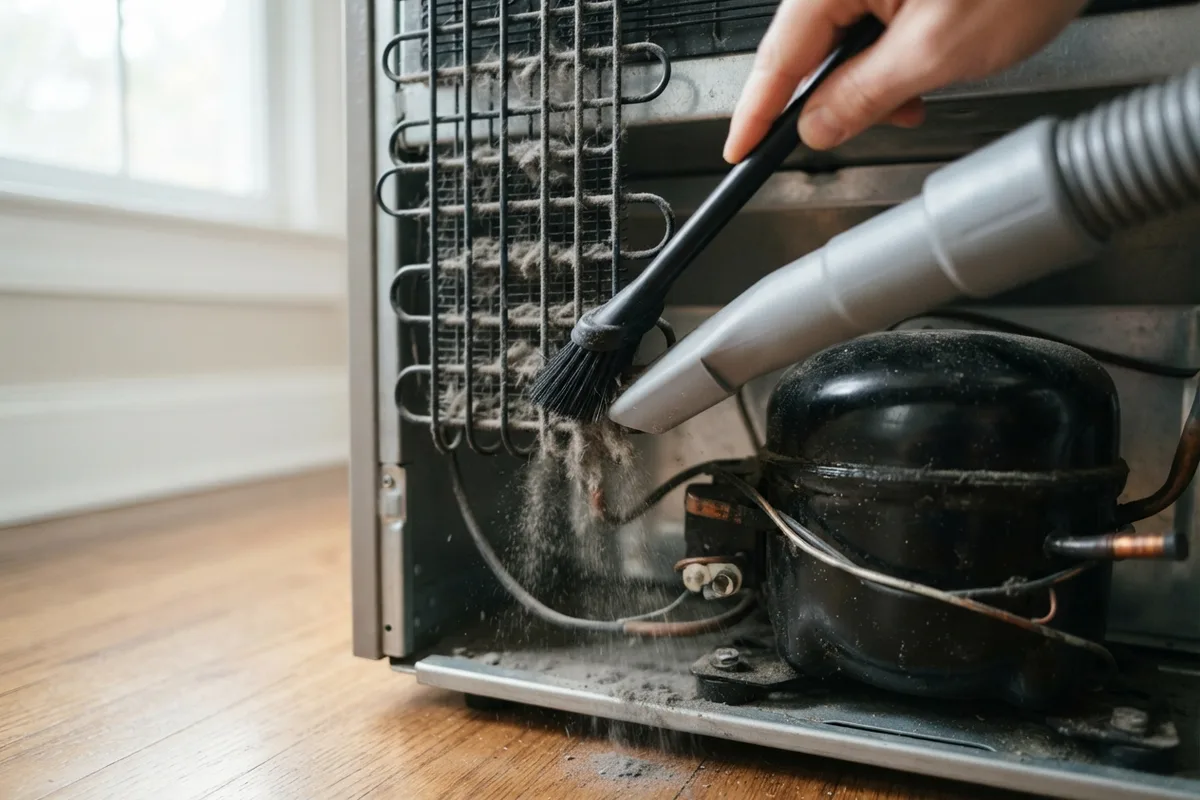
- Use a flexible coil cleaning brush to gently dislodge compacted lint between the serpentine metal tubing.
- Vacuum the loosened debris using a crevice or brush attachment on your household vacuum cleaner.
- Wipe away any surrounding dirt from the floor and lower mechanical bay to ensure proper airflow around the compressor housing.
Regular coil cleaning is one of the top ways to maintain cooling performance and extend appliance lifespan without buying expensive replacement parts.
Check the Condenser Fan Motor Operation
The condenser fan sits right next to the compressor in the rear service compartment, pulling cool kitchen air across the coils and motor. If this fan stalls due to dirt, an obstruction, or a dead motor bearing, heat rapidly builds up around the compressor body, causing the overload relay to trip repeatedly.
- With the refrigerator unplugged and the rear panel off, visually inspect the fan blades for tangled debris, pet hair, or stray wiring.
- Spin the fan blades by hand. They should spin freely with minimal resistance; if the shaft feels stiff or grinding, the motor bearings have seized.
- If clear of obstructions, plug the refrigerator in briefly and observe if the fan spins up alongside the cooling call.
- Unplug the refrigerator immediately if the fan hums without moving or does not spin at all.
- Replace the condenser fan motor assembly by disconnecting the wire clip and unbolting the mounting bracket from the cabinet frame.
Inspect the Overload Capacitor for Swelling
Many modern refrigerators utilize a separate run or start capacitor attached to the relay to provide consistent operational voltage to the compressor motor. If the capacitor fails, the compressor cannot draw enough current to start against line pressure, leading to continuous clicking cycles that result in refrigerator food spoiling fast.
- Disconnect refrigerator power before touching any electrical capacitors.
- Locate the capacitor, which is typically a rectangular or cylindrical plastic housing clipped beside the start relay.
- Visually inspect the casing for bulges, cracks, oily residue, or burnt terminals.
- If you have a digital multimeter capable of measuring capacitance (microfarads/µF), safely discharge the capacitor using an insulated screwdriver across the terminals and test its reading against the rating printed on the label.
- If the reading is more than 10 percent off spec, snap in a replacement capacitor matching the exact voltage and microfarad values.
Verify Clean Power and Proper Outlet Voltage
A refrigerator compressor requires stable, dedicated power to overcome initial head pressure during startup. If your refrigerator shares a circuit with heavy kitchen loads or is plugged into an improper extension cord, voltage drop can starve the compressor motor during startup, triggering the overload relay to click repeatedly.
| Issue Type | Typical Symptom | DIY Verification | Difficulty Level | Estimated DIY Part Cost |
|---|---|---|---|---|
| Bad Start Relay | Shaking rattle, burn marks | Shake test / Multimeter resistance | Easy | $15 – $45 (varies by model) |
| Dirty Coils | Compressor hot, weak cooling | Visual inspection under/behind unit | Easy | $0 (Brush/Vacuum) |
| Bad Condenser Fan | Stiff blades, no airflow | Manual spin test / Visual check | Moderate | $35 – $95 (varies by model) |
| Weak Capacitor | Bulging casing, low microfarads | Multimeter capacitance test | Moderate | $12 – $35 (varies by model) |
| Low Wall Voltage | Clicking during peak kitchen use | Multimeter outlet voltage check | Easy | $0 (No parts needed) |
- Ensure the refrigerator power cord is plugged directly into a grounded 115V-120V wall receptacle without any surge strips, adapters, or light-gauge extension cords.
- Use a multimeter to verify the outlet supplies between 108V and 126V under standard household load conditions.
- If the voltage drops below 108V when other appliances run, consult an electrician to balance the branch circuit.
When to Call a Pro
If you have replaced the start relay, cleaned the coils, and confirmed proper voltage, but the compressor still clicks every few minutes without starting, the compressor itself may have an internal mechanical seizure (locked rotor) or shorted motor windings.
Internal compressor repairs and refrigerant handling involve pressurized sealed systems and brazing equipment that require specialized diagnostic gauges and recovery tools. Attempting to cut into sealed refrigerant tubing is dangerous and should never be done as a DIY project. In these scenarios, scheduling dedicated refrigerator repair is the safest next move. If you need assistance finding a skilled technician in your neighborhood, True Appliance Repair can match you with a local appliance pro to diagnose complex motor or sealed-system faults.
FAQ
Why does my refrigerator click every 2 to 3 minutes?
A regular clicking cycle every few minutes is the sound of the thermal overload switch resetting, attempting to send power to the compressor motor, overheating almost immediately, and tripping open again. This is typically caused by a blown start relay, dirty coils, or a locked compressor motor.
Can I run my refrigerator while the compressor is clicking?
You should unplug the refrigerator if the compressor is clicking and failing to start. Allowing the unit to continuously attempt startups can overheat the electrical windings, damage adjacent control boards, and turn a simple relay fix into a major compressor breakdown.
How much does it cost to fix a clicking refrigerator compressor?
A DIY start relay or capacitor replacement usually costs between $15 and $50 for the part. If a technician handles the replacement, typical repair visits range between $130 and $280 depending on the model and labor rates in your area. Replacing the actual compressor unit is significantly more expensive, often ranging from $600 to $1,100 depending on parts and local labor rates.
How do I know if the compressor is completely dead?
A compressor is likely dead if a brand new, verified start relay and capacitor still fail to turn the motor over, or if a multimeter shows zero resistance (shorted circuit) or infinite resistance (open winding) between the three terminal pins on the compressor body.