
Opening your washing machine during a sanitize or heavy-duty cycle only to find freezing cold water is frustrating. Hot water is essential for lifting stubborn body oils, dissolving powdered detergents, and killing germs on towels and bedsheets. When your appliance suddenly runs cold, the culprit is usually a simple mechanical restriction or a worn control component rather than a complete machine breakdown.
Before you spend money on unnecessary parts, follow this troubleshooting guide to isolate the problem. Always remember to unplug your washing machine and shut off both the hot and cold water supply valves behind the unit before inspecting internal parts or disconnecting hoses.
Check the Hot Water Supply Valve Behind the Washer
The most straightforward cause of a hot water failure is a partially or fully closed shutoff valve. Over time, dual-supply laundry faucets or dual-handle ball valves behind the machine can be bumped by laundry baskets, or internal mineral scale can restrict the water gate.
To verify flow:
- Pull the washer away from the wall carefully to access the plumbing connections.
- Locate the hot water supply tap (usually color-coded red or on the left side).
- Turn the handle counterclockwise completely to confirm it is fully open.
- If the valve feels stuck or stiff, shut off the main water supply, unscrew the hot hose into a 5-gallon bucket, and slowly open the tap to confirm strong water pressure.
If water barely trickles into the bucket, your issue lies within your home plumbing or water heater rather than the washing machine itself.
Clean the Hot Water Inlet Screen Filters
Sediment, rust particles, and mineral grit often travel through household plumbing and collect directly at the entrance of your washing machine. Every modern washer features small mesh filter screens embedded inside the water inlet valve connections on the back panel. When the hot side screen clogs, hot water cannot enter the tub.
To clean clogged screens:
- Shut off the hot water valve and disconnect the electrical plug.
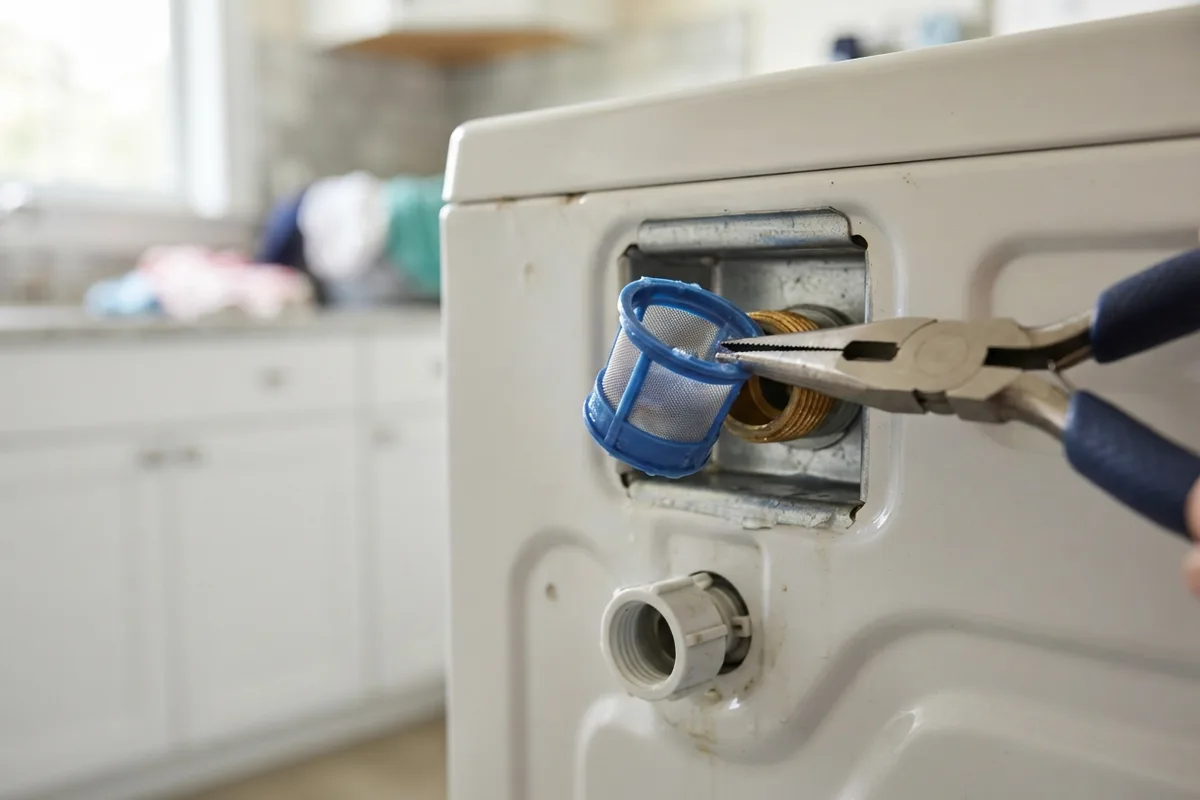
- Unscrew the hot water fill hose from the back of the washer using slip-joint pliers.
- Look inside the threaded valve port to find the small plastic or metal mesh basket.
- Use needle-nose pliers or tweezers to gently pull the screen out without puncturing the mesh.
- Soak the screen in warm white vinegar for 15 minutes, scrub away mineral scale with an old toothbrush, rinse thoroughly, and press it back into place.
Cleaning these small strainers is one of several hidden appliance filters you should clean regularly to maintain peak household performance.
Inspect the Hot Water Fill Hose for Kinks or Pinches
When a washing machine shifts during a high-speed spin cycle, it can push backward against the wall and severely kink the flexible rubber or braided stainless steel supply lines. A severe bend acts like a crimp in a garden hose, choking off hot water completely while the cold line remains open.
Inspect the entire length of the hot water hose from the wall outlet box down to the washer connection:
- Smooth out any sharp angles or flat spots.
- Ensure the machine sits at least 3 to 4 inches away from the wall to give hoses adequate bend radius.
- If rubber hoses feel brittle, stiff, or collapsed internally from years of heat exposure, replace them with burst-resistant stainless steel braided lines.
If you live in an area with hard water, scale can also narrow the hose interior over time. You can learn more about managing mineral deposits in our guide on how to remove hard water from appliances.
Test the Water Inlet Solenoid Valve
Your washing machine uses an electric dual-solenoid water inlet valve to mix hot and cold water to reach chosen cycle temperatures. If the hot water solenoid burns out or its internal spring gets stuck closed, the washer will never call in hot water, even if water pressure at the wall is normal.
| Issue Indicator | Likely Component Fault | DIY Difficulty | Next Step |
|---|---|---|---|
| No water when Hot selected, normal on Cold | Hot inlet solenoid coil burned out | Moderate | Test coil with multimeter for continuity |
| Slow warm trickle on all cycles | Clogged inlet screen / scale | Easy | Remove and clean mesh filter |
| Cold water enters when Hot is chosen | Reversed supply hoses | Easy | Swap hose connections at the back |
| Machine fills continuously with warm water | Stuck mechanical valve diaphragm | Moderate | Replace complete inlet valve assembly |
| Error code displaying (IE, 4E, or nF) | Low water pressure / flow fault | Easy to Moderate | Check supply taps and inlet screens |
To test the solenoid:
- Unplug the machine and remove the rear access panel or top console (depending on front-load vs. top-load design).
- Locate the inlet valve assembly where the hoses screw in.
- Disconnect the wire harness terminals from the hot water solenoid.
- Set a digital multimeter to the lowest ohms (Ω) setting and touch the probes to the valve terminals.
- A functional solenoid typically reads between 500 and 1,500 ohms. A reading of zero or infinite resistance (O.L.) means the internal coil has failed and the valve assembly must be replaced.
Check the Water Temperature Selector Switch or Sensor
On older mechanical washing machines, a rotary temperature selector switch routes electric current to the inlet valve solenoids based on your chosen setting (Hot/Cold, Warm/Warm, Cold/Cold). On newer digital models, an electronic thermistor (temperature sensor) monitors incoming water heat and signals the control board to balance the valves.
If the selector switch contacts become scorched or oxidized, current never reaches the hot solenoid:
- For rotary switches: Unplug the machine, remove the console panel, and test continuity across the hot terminal contacts with your multimeter while turning the knob.
- For modern electronic washers: If incoming hot water is below roughly 120°F at your home water heater, the machine's "energy-saving" automated temperature control (ATC) may blend in heavy amounts of cold water to prevent thermal fabric damage, making the wash cycle feel lukewarm.
When to Call a Pro
If you have verified that your wall taps supply strong hot water, cleaned your mesh screens, and confirmed your hoses are clear, the issue may stem from a malfunctioning main control board, a faulty thermistor, or an internal wiring harness break. Testing live control circuits carries electrical risks.
If you prefer not to disassemble control panels or handle wiring diagnostics, a local technician can pinpoint the issue quickly. If the fix turns out to be part of a larger mechanical failure, True Appliance Repair can match you with an independent local pro to restore your laundry routine without the hassle.
FAQ
Why does my hot wash cycle feel lukewarm instead of hot?
Most modern energy-efficient washers utilize Automatic Temperature Control (ATC) algorithms. Rather than filling straight from the hot water line, the machine mixes hot and cold water to maintain an energy-efficient target range (typically around 85°F to 105°F for warm and 115°F to 130°F for hot). If your home water heater is set below 120°F, the incoming mix will feel noticeably cooler.
Can reversed supply hoses cause my washer not to get hot?
Yes. If the cold water supply line is accidentally connected to the washer's hot water inlet port (and vice versa), the machine will dispense cold water during hot cycles and hot water during rinse cycles. Check the embossed "H" and "C" markings on the back of your washer to confirm your hoses match.
How much does it cost to replace a washing machine water inlet valve?
A replacement water inlet valve part generally ranges from $25 to $75 for most common brands. If you hire a professional technician to diagnose and replace the assembly, total repair costs typically range from $130 to $260 depending on your area, washer brand, and machine access.