
Nothing ruins a family dinner or holiday baking spree faster than an oven that quits halfway through cooking. When your range starts acting erratic, it can be tough to tell whether you are dealing with a simple worn-out part or a major breakdown. Use these seven clear warning signs to figure out if your oven needs a quick tune-up, a professional repair, or a full replacement.
Safety First: Before inspecting any internal oven components, always unplug the range from the wall outlet or switch off its dedicated circuit breaker at your home's electrical panel. If you have a gas range, turn off the gas shut-off valve behind the unit before moving it, and never attempt DIY work on gas lines or internal gas valves.
1. Food Takes Forever to Bake or Comes Out Raw
If a casserole that used to take 40 minutes now takes an hour, or cakes come out sunken and doughy in the center, your oven is struggling to hold its set temperature. Before assuming the whole range is shot, do a few simple checks to pinpoint the cause:
- Hang an inexpensive analog oven thermometer from the center rack, preheat to 350°F, and check the reading after 20 minutes.
- If the temperature is off by only 15 to 25 degrees, check your owner's manual to calibrate the thermostat dial or digital control settings.
- In an electric oven, turn the bake cycle on briefly and look for a steady, even red glow across the bottom heating element; dark spots mean the element is burning out.
- In a gas oven, watch the bottom igniter glow; if it takes more than 90 seconds to light the gas burner, the igniter is weak and needs replacement.
- Inspect the temperature sensor probe—a thin metal rod sticking out of the upper back wall—to make sure it is not touching the oven wall or coated in baked-on grease.
2. Burnt Edges and Raw Centers Every Time
When cookies burn on the bottom while the tops stay pale, or one side of a sheet pan browns twice as fast as the other, heat is not circulating properly inside the cavity. Uneven baking is often fixable without replacing the appliance:
- Remove any aluminum foil from the oven racks or the bottom floor of the oven; foil blocks critical airflow vents and reflects heat unevenly.
- Check your bakeware—dark, heavy metal pans absorb more radiant heat and brown edges much faster than shiny aluminum pans.
- If you have a convection oven, turn on the convection setting and listen or look through the window to confirm the back fan blades spin freely.
- With the power disconnected, inspect the top broil element and bottom bake element for warping, sagging, or detached mounting brackets.
- Make sure your racks are sitting flat and level in their side grooves, and avoid crowding multiple large pans onto a single rack.
3. Visible Sparks, Blisters, or Cracks on Elements
Your electric heating elements endure extreme thermal stress every time you bake or broil. Over the years, the protective outer metal sheath can degrade, allowing the live resistance wire inside to short against the metal tube. If you ever see bright sparks or small flames inside an electric oven, turn the oven off at the control panel and flip the circuit breaker immediately.
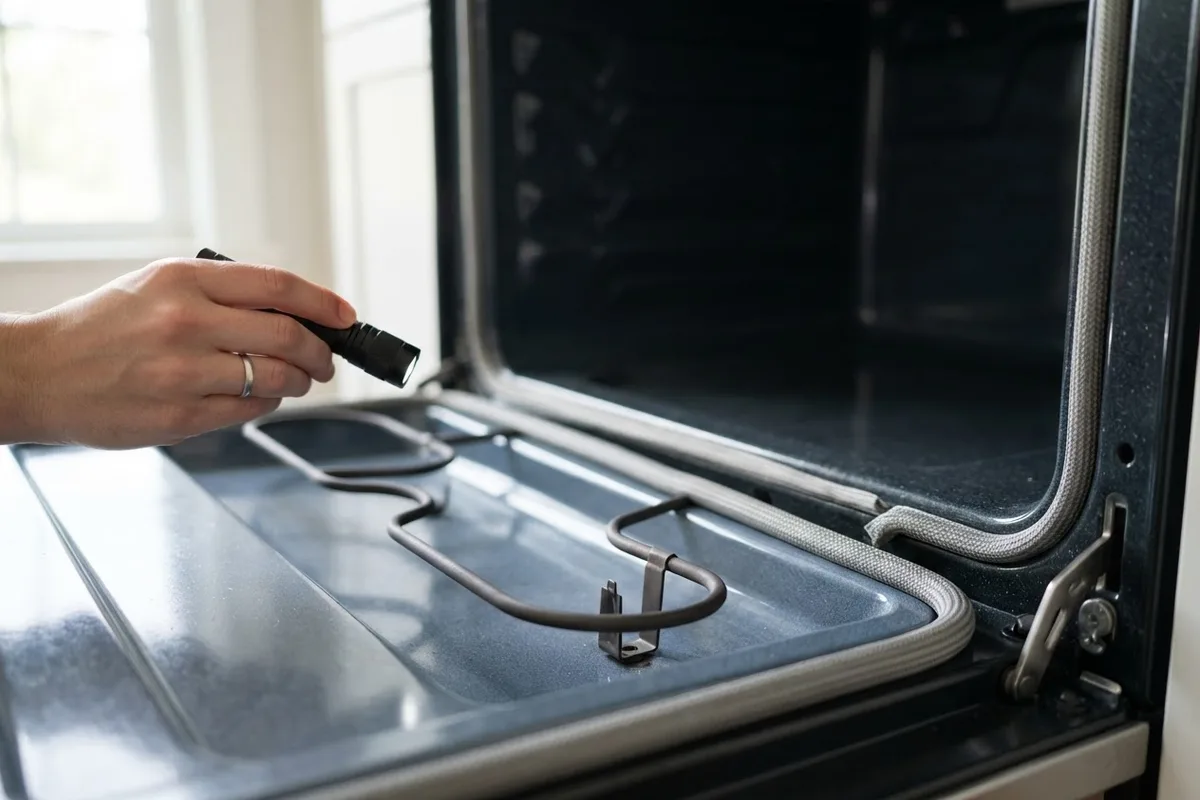
Once the oven has cooled completely and the power is disconnected at the breaker, grab a flashlight and run your eyes along the entire length of both the bake and broil elements. Look for raised blisters, pinholes, splits, brittle gray crust, or burned spots. Check our guide on why an electric oven is sparking for a deeper breakdown of what causes electrical arcing. Fortunately, a blistered bake element is usually an affordable part swap rather than a reason to scrap the whole range.
4. Strange Noises, Clicking, or Gas Smells
An oven should operate relatively quietly aside from the soft click of a thermostat relay or the gentle hum of a cooling fan. New or worsening sounds—or any whiff of gas—demand immediate attention:
- Continuous clicking on a gas stove: Often caused by moisture or grease trapped under a burner cap; let the burner dry completely and realign the cap flat.
- Loud whooshing or delayed thump when lighting: Indicates a weak gas igniter allowing gas to build up slightly before ignition—stop using the oven and have the igniter serviced.
- Hissing or rotten-egg odor: If you hear an unusual hiss, review our safe checks for a hissing gas stove. If you smell gas while all knobs are off, do not flip any electrical switches; leave the house immediately and call your gas utility.
- Rattling or metallic grinding: Usually points to a worn convection fan motor bearing or a cooling blower wheel rubbing against its housing.
5. Control Panel Glitches and Unresponsive Buttons
Modern ranges rely on an electronic control board and a ribbon-style touchpad membrane to regulate baking modes, timers, and safety locks. Because this electronics hub sits directly above or behind a hot oven cavity, years of heat and kitchen steam eventually take a toll on solder joints and relays.
- Try a hard reset first: flip the oven's circuit breaker off for five full minutes, then turn it back on to clear temporary microprocessor glitches.
- Check if the "Control Lock" or "Child Lock" icon is illuminated on the display; holding the lock button for three seconds usually restores normal keypad use.
- Write down any alphanumeric error codes (like F1, F3, or E1) that flash on the screen accompanied by beeping.
- Note if specific buttons require hard pressing or no longer respond at all, which points to a failing touchpad membrane.
- Keep in mind that replacing a main electronic control board on an older range is one of the priciest repairs—often tipping the scales toward buying a new unit.
6. Oven Door Won't Seal and Heat Escapes
When heat leaks out around the oven door, the elements or burner must run non-stop to maintain temperature. This wastes energy, cooks food unevenly, and can overheat the control panel knobs right above the door. You can check the door system in a few minutes:
- With the oven cool, run your fingers along the rubber or braided fiberglass gasket framing the door opening.
- Look for flattened spots, fraying, brittle cracks, or sections that have pulled loose from their mounting clips.
- Open the door halfway and let go; if the door slams down or refuses to stay snug against the front frame when closed, the internal door hinges are fatigued.
- Do the paper test: close the oven door on a dollar bill or strip of paper at several points around the perimeter. If the paper slides out with zero resistance, the seal or hinges need replacing.
7. Your Oven Is Past Its Expected Lifespan
Even a well-maintained appliance eventually reaches the point where fixing one part only buys a few months before another component wears out. On average, electric ranges last about 13 to 15 years, while gas ranges typically last 15 to 18 years due to having fewer high-wattage heating parts that degrade.
A smart rule of thumb for homeowners is the 50% rule: if your oven is more than halfway through its expected lifespan and the cost of a repair approaches 50% of the price of a comparable new range, replacement is usually the better financial move. Just as you would weigh your options when spotting the signs your refrigerator is dying, stacking repair bills against the age of your oven helps prevent sinking money into a dying machine.
Oven Repair vs. Replace Quick Guide
Note: Typical US repair cost ranges below include parts and labor and vary by local area, appliance brand, and model.
| Symptom or Failed Part | Typical US Repair Cost | Best Move (Under 10 Yrs Old) | Best Move (Over 12–15 Yrs Old) |
|---|---|---|---|
| Torn or flat door gasket | $80 – $180 | Repair (easy DIY or pro fix) | Repair |
| Burned-out bake element | $120 – $250 | Repair | Repair if otherwise healthy |
| Weak gas oven igniter | $150 – $300 | Repair | Repair if burners work well |
| Faulty temperature sensor | $110 – $220 | Repair | Repair |
| Worn door hinges | $150 – $300 | Repair | Consider replacement |
| Bad convection fan motor | $200 – $400 | Repair | Replace if other issues exist |
| Failed electronic control board | $300 – $650+ | Repair on mid/high-end models | Replace the oven |
When to Call a Pro
Swapping out a clip-in door gasket, leveling oven racks, or cleaning a greasy burner cap are straightforward weekend projects for most homeowners. However, any issue involving gas valves, internal gas leaks, 240-volt wiring harnesses, or main electronic control boards should be left to an experienced technician. Working with live high-voltage circuits or gas connections carries serious safety risks if a connection is loose or misdiagnosed.
If you aren't sure whether your range needs a simple sensor swap or is ready for retirement, getting an accurate diagnosis is the smartest first step. True Appliance Repair can match you with a local pro for oven and stove repair who can test your components safely and give you an honest repair estimate.
FAQ
How long do electric and gas ovens typically last?
Most electric ovens last between 13 and 15 years with normal household use, while gas ovens often last 15 to 18 years. Regular cleaning, avoiding heavy aluminum foil on the oven floor, and going easy on the high-heat self-clean cycle can help your range reach the upper end of its lifespan.
Is it worth fixing a 10-year-old oven?
Yes, if the problem is a common wear-and-tear component like a bake element, temperature sensor, door gasket, or gas igniter. Those repairs typically cost between $110 and $300 (varies by area and model), which is far less than purchasing and installing a brand-new range.
Why did my oven suddenly stop heating, even though the clock and lights work?
Electric ovens run on 240-volt power using a double-pole breaker, while the clock and interior light only need 120 volts. If half of the breaker trips, the display will light up normally, but the heating elements won't receive power. Reset the double breaker at your electrical panel first; if it still won't heat, a burned-out bake element or blown thermal fuse is the likely culprit.
Can running the self-clean cycle kill an older oven?
It can push weak parts over the edge. Self-cleaning locks the door and heats the cavity to around 800°F–900°F for several hours, which puts heavy heat stress on the thermal fuse, door lock motor, and electronic control board. On older ovens, it is much safer to clean spills manually with a baking soda paste and damp cloth.