
When your dishwasher starts vibrating hard enough to rattle the countertop or hum through the kitchen floor, something is out of balance inside or underneath the tub. Left unchecked, excessive shaking can loosen water lines and wear out motor mounts prematurely. Follow these five step-by-step fixes to track down the vibration and get your kitchen quiet again.
Safety First: Before inspecting underneath the dishwasher, adjusting leveling legs, or touching any internal components, always unplug the unit under the sink or shut off its circuit breaker at your home's electrical panel, and turn off the water supply valve.
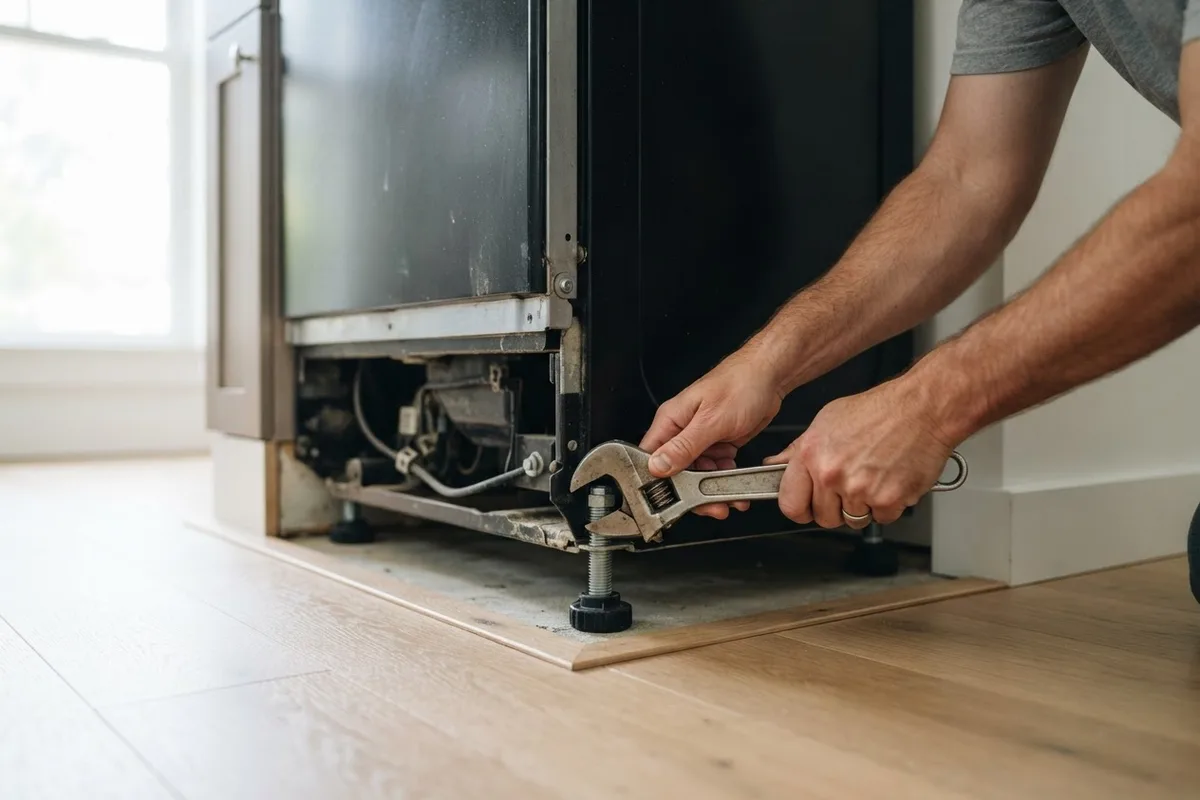
1. Level the Front and Rear Legs
A dishwasher that does not sit flat on all four feet will rock and vibrate every time the circulation pump kicks into high gear. Even a tiny gap between one leveling leg and the subfloor gets amplified when gallons of hot water start sloshing around inside the tub.
- Open the dishwasher door and place a carpenter's level across the top front edge of the tub opening to check side-to-side balance.
- Place the level vertically along the inside wall or door track to check front-to-back tilt.
- Remove the lower access kickplate at the base of the dishwasher (usually held by two Phillips or Torx screws).
- Use an adjustable wrench or pliers to turn the front leveling legs clockwise to lower that corner or counterclockwise to raise it until all feet press firmly against the floor.
- For models with a single center rear leg, turn the front adjustment screw at the base with a screwdriver to level the back of the unit.
2. Tighten Loose Mounting Brackets
Every time you tug the door open or roll out a heavy bottom rack, the metal brackets holding the dishwasher to your countertop or cabinets take the strain. Over time, those screws back out. If your whole unit shifts when it runs, check our full guide on why a dishwasher gets loose under the counter or tighten the brackets right now.
- Open the dishwasher door and look along the top lip or inside side walls of the frame for the two metal mounting tabs.
- Grab the top frame of the dishwasher and gently push and pull; if it moves even a fraction of an inch, the brackets are amplifying motor vibration.
- Tighten the bracket screws firmly with a Phillips screwdriver.
- If the screw spins freely in stripped particleboard underneath a laminate counter, remove the screw, dip a wooden toothpick in wood glue, tap it into the hole, and drive the screw back in.
- For stone or quartz countertops, verify that side-mount screws are anchored securely into the cabinet frames behind the rubber grommets.
3. Rearrange Dishes and Check Rack Rollers
Not every vibration is a mechanical failure. High-pressure water jets hit dishes with surprising force, and lightweight items or a wobbly dish rack can create a steady, rhythmic shudder throughout the wash cycle. If a damaged roller is making the basket bind or sit crooked, see these fixes for when a dishwasher rack gets stuck.
- Open the unit and inspect how heavy pots, mixing bowls, and baking sheets are loaded; keep heavy items centered or evenly split on the bottom rack rather than piled on one side.
- Separate nesting bowls, pan lids, and tall glasses so water jets do not bounce them against each other or against the stainless steel tub wall.
- Pull both racks out and inspect the plastic wheels and axle clips; replace any cracked or missing wheels that let the rack bounce during spray cycles.
- Spin the upper and lower spray arms by hand to verify they do not strike tall plates or silverware handles, which causes a loud thumping vibration.
4. Cushion Rattling Water and Drain Hoses
Beneath the dishwasher tub and inside the adjacent sink cabinet, the copper or braided stainless water supply line and the corrugated plastic drain hose snake through tight cutouts. As water pulses through the valves and pumps, unsecured hoses slap against the subfloor or wood cabinet divider, sending a buzzing vibration through the room.
- Shut off the breaker and remove the lower kickplate using a screwdriver.
- Shine a flashlight underneath the machine and look inside the cabinet under the kitchen sink where the hoses pass through the wall.
- Gently wiggle the water inlet line and the ribbed drain hose to see if either one taps against the cabinet wall, floor, or metal dishwasher frame.
- Wrap a piece of split foam pipe insulation around the hose right where it passes through the cabinet hole or rests near the floor.
- Secure loose loops of drain hose inside the sink cabinet with a plastic cable strap or zip tie so the hose stays suspended in a high loop without touching the cabinet back.
5. Inspect the Motor Mounts and Pump Impeller
If the cabinet, racks, and hoses are all tight and the machine still hums and vibrates violently, the issue is likely inside the circulation or drain pump assembly. Hard objects like fruit pits, olive stones, or broken glass can slip past the sump cover and lodge in the spinning impeller, throwing the motor off balance like an unbalanced car tire.
- Disconnect electrical power and pull out the bottom dish rack.
- Remove the lower spray arm and twist out the cylindrical filter and flat sump cover at the floor of the tub.
- Wearing cut-resistant work gloves, sponge out any standing water and shine a flashlight into the sump basin to check for bone fragments, glass shards, or seeds near the impeller blades.
- Reach underneath the unit (with the kickplate off) and visually inspect the rubber motor mounts holding the circulation pump to the base frame.
- If the rubber isolator pads look cracked, sagged, or torn, or if the motor shaft wiggles loosely, stop here—the pump assembly or mounts will need replacement.
Quick Troubleshooting Guide: Dishwasher Vibrations
| Vibration Symptom | When It Happens | Most Likely Cause | DIY Difficulty |
|---|---|---|---|
| Whole machine rocks slightly | Throughout the entire cycle | Uneven leveling legs | Easy (10 mins) |
| Countertop buzzes or rattles | When opening door or mid-wash | Loose top or side mounting brackets | Easy (5 mins) |
| Rhythmic thumping or clattering | During main wash spray only | Unbalanced load or loose rack wheels | Easy (5 mins) |
| Knocking under the kitchen sink | During water fill or drain out | Supply line or drain hose hitting cabinet | Easy (15 mins) |
| Loud humming with floor vibration | Constantly while motor runs | Jammed pump impeller or worn motor mounts | Moderate to Pro |
When to Call a Pro
Adjusting leveling feet, tightening cabinet brackets, and cushioning rattling hoses under the sink are safe, straightforward weekend tasks that require only basic hand tools. Adding these quick checks to your annual appliance maintenance routine will keep your kitchen quiet and prevent wear on plumbing joints.
However, if the vibration comes with a harsh grinding roar, a burning smell, or water pooling under the unit, the circulation pump bearings or rubber motor mounts have likely failed. Replacing a main wash motor involves tipping the appliance on its back, disconnecting wiring harnesses, and resealing the main sump gasket. Typical US repair costs for replacing a dishwasher circulation pump or motor assembly range from $180 to $350 including parts and labor, though exact pricing varies by area and model. If you would rather not wrestle the unit out from under the counter, True Appliance Repair can connect you with an independent local pro for professional dishwasher repair.
FAQ
Is it safe to run a vibrating dishwasher?
If the vibration is mild and caused by rattling dishes or a loose drain hose, it is safe to finish the cycle. However, if the entire frame is shaking hard or making a loud grinding sound, shut the machine off immediately so the vibration does not loosen the water inlet fitting and cause a leak.
Why does my dishwasher only vibrate when it drains?
A dishwasher has two separate motors or pump stages: one for washing and one for draining. If the unit only vibrates during the final two-minute drain phase, a small piece of debris like a popcorn kernel or glass shard is likely caught in the drain pump impeller, throwing it off balance as it spins at high speed.
Can missing sound insulation make my dishwasher vibrate?
The heavy cotton or bitumen sound blanket wrapped around the outside of the dishwasher tub helps dampen normal operating vibrations and noise. If the blanket slips down after an installation or gets torn during a move, the sheet-metal side panels can buzz against the adjacent cabinet walls.
How much does it cost to fix a vibrating dishwasher?
Most vibration fixes cost $0 to $15 if you just need wood screws, toothpicks, or a piece of foam pipe insulation from the hardware store. If a local technician needs to clear a deep pump blockage or replace worn motor mounts, typical service costs range between $120 and $280 depending on your location and dishwasher brand.