
You load the racks, press start, and listen for the familiar rush of water—only to hear an empty hum and find bone-dry dishes an hour later. A dishwasher not filling with water is one of the most common kitchen headaches, especially during busy holiday cooking seasons when the machine runs daily. The good news is that the culprit is usually a simple mechanical block or a tripped safety sensor you can inspect yourself in under thirty minutes.
Safety First: Before inspecting any internal components, unplug your dishwasher from the wall outlet or switch off its dedicated circuit breaker at your home's electrical panel. Always shut off the hot water supply valve under the kitchen sink before disconnecting any water lines.
1. Check the Hot Water Shut-Off Valve and Supply Line
Before taking anything apart, verify that water can actually reach the appliance. If someone recently worked under the kitchen sink, retrieved a bottle of cleaner from the back of the cabinet, or installed a new faucet, the supply valve may have been bumped closed or the hose pinched.
- Open the cabinet beneath your kitchen sink and locate the hot water supply line that branches off toward the dishwasher.
- Check the shut-off valve handle. Turn it counterclockwise all the way to ensure it is completely open. (If you have a quarter-turn ball valve, the handle should sit parallel to the pipe).
- Follow the braided stainless steel or copper supply line from the valve to where it enters the dishwasher cabinet space.
- Feel along the hose for sharp kinks, crushed sections, or heavy storage bins pressing against the line.
- Straighten any gentle bends so water can flow at full pressure. If a copper line is creased flat, shut off the water and replace it with a flexible braided stainless steel dishwasher hose.
2. Free a Stuck Float Switch in the Tub Floor
Every dishwasher has an overflow protection mechanism—usually a small plastic dome or cylinder sitting in the front corner of the interior tub floor. As water enters, this float rises. Once it reaches the proper height, it trips a micro-switch underneath the tub to shut off the water. If dried food debris, grease, or a fallen fork holds the float in the "up" position, the dishwasher thinks it is already full and refuses to let water in.
- Open the dishwasher door and slide out the bottom dish rack to clear your workspace.
- Locate the plastic float dome near the front left or right corner of the floor.
- Lift the float gently with your fingers and let it drop. It should move smoothly up and down by about half an inch and make a faint clicking sound as it engages the switch below.
- If it feels sticky or stays up, check see if a retaining nut holds it from underneath, or if it simply snaps out by pulling straight up.
- Wash the float stem and the narrow tube it sits in with warm, soapy water and an old toothbrush to clear out stuck-on residue.
- Reinstall the float, confirm it drops freely, and test a quick rinse cycle.
3. Clean the Water Inlet Valve Screen
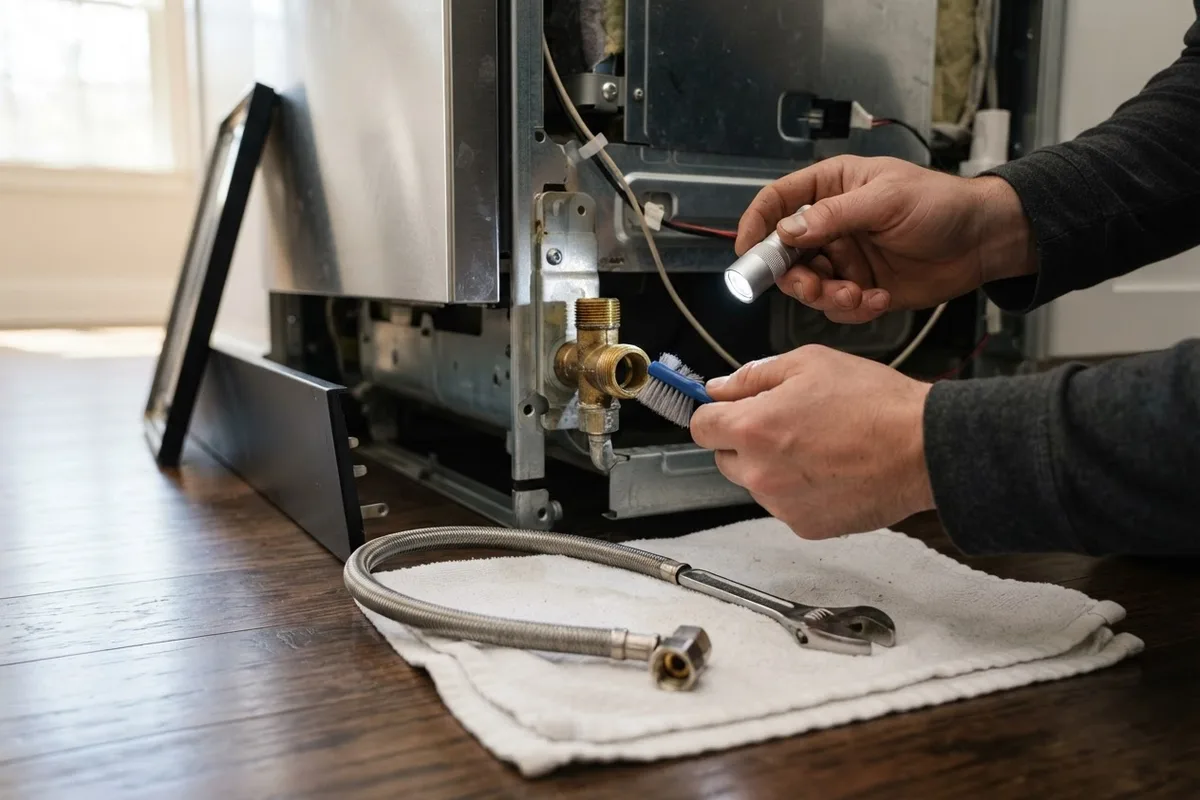
The water inlet valve is the electronic gatekeeper mounted behind the bottom kickplate of your dishwasher. Inside its brass threaded port sits a fine mesh screen designed to catch rust flakes, hard water scale, and sediment from your household pipes. Over time, this screen can clog completely, starving the machine of water even when the valve opens properly.
- Turn off the circuit breaker to the dishwasher and shut off the hot water supply valve under the sink.
- Place a shallow pan and an old towel on the floor in front of the dishwasher to catch residual water in the line.
- Use a screwdriver or nut driver to remove the two to four screws holding the bottom front access panel (kickplate) in place, then set the panel aside.
- Locate the water inlet valve near the front left or right corner, where the main water supply line attaches.
- Use an adjustable wrench to slowly unscrew the water supply fitting from the inlet valve, letting any trapped water drain into your pan.
- Shine a flashlight inside the valve's inlet port to inspect the small mesh screen.
- Do not remove the screen—most are permanently pressed in. Instead, gently brush away mineral buildup and sediment using a soft toothbrush dipped in white vinegar, then blot clean with a cloth.
- Reattach the water supply line snugly, turn the water valve back on to check for drips, and restore power.
4. Inspect and Align the Door Latch Assembly
Dishwashers are wired so the water inlet valve cannot receive power unless the door is firmly closed and latched. If the metal strike plate on the door is slightly bent, or if the latch switches inside the top of the door are worn out, the control panel might light up and count down the timer while refusing to open the water valve.
- Open the dishwasher door and inspect the metal or plastic strike hook at the top center of the frame.
- Check for loose mounting screws. If the strike wiggles, tighten the screws with a Phillips or Torx screwdriver while keeping it centered.
- Look along the rubber door gasket for twisted corners, swollen rubber, or large serving utensils in the top rack that might be pushing the door outward by a fraction of an inch.
- Close the door firmly and listen for a solid mechanical click. If the door feels spongy or pops back slightly, adjust the leveling legs at the bottom front of the machine so the cabinet sits square in its counter opening.
- If your dishwasher is also struggling with heat after you get it running, check out our guide on why your dishwasher is not drying dishes.
5. Reset the Control Board and Check Delay Start
Modern dishwashers rely on electronic control boards and water-sensing algorithms. Occasionally, a minor power flicker or an accidental button press enables the "Delay Start" feature or leaves the main control board stuck in an unfinished drain loop from the previous cycle.
- Look closely at the display panel for a lit "Delay," "2 Hr," or "4 Hr" indicator light. If active, press and hold the Cancel/Drain button for three seconds until the light clears.
- If the panel is responsive but no water enters on a fresh cycle, perform a hard power reset.
- Walk to your home's electrical breaker box and flip the dishwasher circuit breaker to the OFF position (or unplug the unit under the sink if it uses a three-prong cord).
- Wait a full five minutes. This allows the capacitors on the electronic control board to discharge completely and clears temporary memory glitches.
- Flip the breaker back on, open and close the dishwasher door once to wake the sensors, and select a normal wash cycle.
6. Test or Replace a Faulty Water Inlet Valve
If the water supply line has strong flow, the screen is clean, and the float moves freely, the electronic solenoid on the water inlet valve itself has likely burned out. When this coil fails, the control board sends voltage calling for water, but the internal plunger never lifts. Notice water pooling on the floor instead? Read our troubleshooting steps for why a dishwasher is leaking from the bottom.
- Shut off the circuit breaker and the under-sink hot water valve, then remove the bottom access panel.
- Locate the water inlet valve and take a clear photo with your phone showing how the wiring harness and rubber fill tube are connected.
- Disconnect the wire harness clip from the valve solenoid.
- Set a digital multimeter to measure resistance (Ohms, Ω) and touch the two probes to the metal terminals on the valve solenoid.
- A healthy solenoid typically reads between 500 and 1,500 ohms (varies by model). If your meter reads "OL" (open loop) or infinite resistance, the solenoid coil is dead and the valve must be replaced.
- Replacing a water inlet valve is a straightforward DIY swap on most models, with replacement parts typically costing $30 to $75.
Dishwasher Not Filling: Quick Troubleshooting Guide
| Symptom You Notice | Most Likely Cause | Typical DIY Time | Typical Cost Range (Varies by Area/Model) |
|---|---|---|---|
| Machine runs completely silent, timer counts down | Door latch misaligned or Delay Start active | 10 mins | $0 – $45 (if latch needed) |
| Humming sound at start, slow trickle of water | Clogged inlet valve screen or kinked hose | 25 mins | $0 – $25 (for new supply hose) |
| Drains briefly at start, then stops before filling | Stuck float switch in the tub floor | 15 mins | $0 (cleaning) – $35 (new switch) |
| Loud click at start, then dead silence and dry tub | Burned-out water inlet valve solenoid | 45 mins | $30 – $75 (DIY part) / $150 – $280 (Pro) |
When to Call a Pro
While cleaning a float switch or flushing a clogged inlet screen takes basic hand tools, some no-fill issues go deeper into the machine's wiring harness or main control board. If you test the water inlet valve and find it is working, yet it never receives voltage from the main board, or if you encounter corroded wiring, leaking copper plumbing valves that refuse to turn, or a seized circulation pump, stop and call a professional technician.
Professional replacement of a dishwasher water inlet valve or float switch assembly typically ranges from $150 to $280 including parts and labor, while main control board repairs generally run $220 to $400 (varies by area and model). If your machine is over nine years old, compare that quote against our appliance lifespan guide before investing in major electronics. When you are ready for hands-off help, True Appliance Repair can connect you with an experienced local technician for professional dishwasher repair.
FAQ
Why is my dishwasher humming when I start it, but not filling with water?
A low humming or buzzing sound right at the start of a cycle usually comes from the water inlet valve trying to open. If the valve solenoid is energized and humming but no water enters, either the hot water supply valve under the sink is shut off, the supply hose is kinked, or the inlet valve screen is packed with sediment.
Can I pour water manually into my dishwasher to see if it washes?
Yes, pouring two to three quarts of warm water directly into the bottom of the dishwasher tub after the initial drain cycle finishes is a classic diagnostic trick. Close the door and resume the cycle—if the spray arms immediately begin spinning and washing, you know the circulation pump works fine and the issue is isolated to the water fill system.
Where is the water inlet valve located on a dishwasher?
On almost all standard built-in dishwashers, the water inlet valve is mounted behind the lower front kickplate (toe panel), tucked just inside the front left or front right corner leg. You can find it easily by tracing the metal or braided water supply line from under the kitchen sink to where it threads onto the dishwasher.
How long does a dishwasher take to fill with water at the start of a cycle?
Most dishwashers begin every cycle by running the drain pump for 30 to 60 seconds to clear out old standing water. Immediately after that brief drain, you should hear water rushing into the tub for about 1 to 2 minutes before the main wash motor kicks on.