
Opening your dishwasher after a full cycle only to find the detergent dissolved at the bottom and food still stuck to your plates usually points to one culprit: a stationary wash arm. Unlike electric fans, dishwasher spray arms do not have their own motors—they spin purely from the force of water shooting out of their angled nozzles. Below, you will learn how to safely troubleshoot and fix a dishwasher spray arm not spinning in six straightforward steps, from clearing hidden blockages to restoring water flow.
Safety First: Before reaching into the bottom of your dishwasher tub or removing internal parts, always unplug the dishwasher from the wall outlet or switch off its circuit breaker at your home's electrical panel. If you plan to inspect the water supply line, turn off the hot water shut-off valve under your kitchen sink first.
1. Clear Tall Dishes and Silverware Blocking the Arm
The simplest reason a spray arm stops turning is a physical obstruction inside the tub. A single tall cutting board, a baking sheet handle, or a long spoon poking through the bottom of the silverware basket can catch the plastic blade mid-rotation and hold it in place for the entire wash cycle.
Follow these steps to test for clearance before starting a wash:
- Pull out the lower rack and look underneath it to see if any pot handles, ladle hooks, or chopsticks are hanging down below the wire grid.
- Move tall plates, pizza pans, and cutting boards to the outer edges of the bottom rack so they do not rub against the upper spray arm mounted beneath the top rack.
- Push both racks all the way in and reach inside to spin both the lower and upper spray arms by hand.
- Listen and feel for any scraping or tapping. Both arms should spin freely for at least two full rotations without hitting a single dish or wire tine.
2. Unclog Blocked Spray Arm Jets and Nozzles
Because the spray arms rely on water propulsion to rotate, just two or three clogged outer holes can rob the arm of the thrust it needs to turn. Hard water mineral scale, lemon seeds, bits of eggshell, and glass fragments frequently get pushed into the narrow jet openings from the inside out.
Here is how to remove and clean the spray arms safely:
- Turn off power to the unit at the breaker and remove the bottom dish rack.
- Twist the central locking nut on the lower spray arm counterclockwise (or unclip the snap tab, depending on your model) and lift the arm straight up and out.
- Hold the arm up to a light and look into the angled corner jets at both ends—these angled holes are what actually drive the spinning motion.
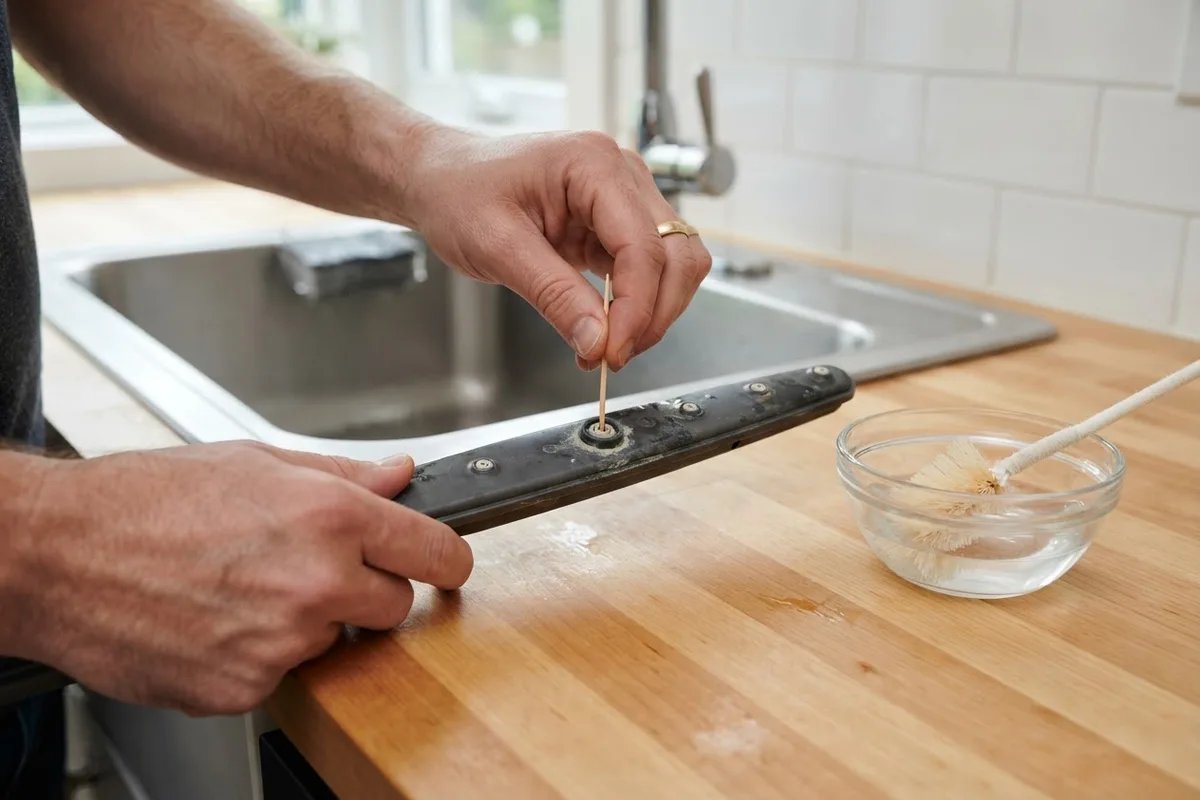
- Use a wooden toothpick or a pair of tweezers to gently push any trapped seeds or debris back toward the wide center opening, then rinse the inside of the arm under the kitchen faucet.
- Soak the spray arm in a shallow pan of warm white vinegar for 30 minutes to dissolve chalky calcium deposits around the nozzles, then scrub lightly with a soft toothbrush and reinstall.
3. Check the Water Level and Float Switch
If the dishwasher does not have enough water in the basin, the circulation pump will suck in air instead of water, resulting in a weak trickle that cannot push the spray arms around. If you notice the tub is bone dry or barely wet ten minutes into a cycle, check out our deeper guide on why your dishwasher is not filling with water.
To check the water level and float mechanism right now:
- Start a normal wash cycle, wait about three minutes for the initial fill sound to stop, and carefully unlatch the door.
- Look at the floor of the tub. Standing water should cover the bottom basin and reach just below the circular heating element.
- Locate the float dome—a small plastic cylinder in the front corner of the tub floor. Lift it up and down with your fingers; it should move smoothly and make a faint clicking sound as it triggers the switch underneath.
- If the float is sticky or jammed in the "up" position by dried food, the dishwasher will think it is already full and will stop letting water in. Wipe around the float stem with warm soapy water until it drops freely.
- Look under the kitchen sink and make sure the hot water supply shut-off valve is turned all the way open (counterclockwise) and that the braided supply hose is not kinked.
4. Inspect the Spray Arm Bearing Ring and Mount
As the spray arm spins thousands of times over the years, the plastic hub where it meets the central support tower can wear down, warp from high heat, or lose its thin nylon bearing ring. When that seal wears out, water gushes straight out the base of the arm instead of pressurizing the outer nozzles, and the arm wobbles or binds against the floor of the tub.
Here is how to check the mounting hub for wear:
- With the power off and the lower rack out, grab the ends of the lower spray arm and gently wiggle it up and down.
- A small amount of play is normal, but if the arm tilts steeply enough to scrape the heating element or tub floor, the center bushing is worn out.
- Unscrew and lift off the spray arm, then flip it over to inspect the round plastic collar on the underside.
- Check for melted plastic edges, hairline cracks along the seam of the arm, or a missing white plastic washer on the central support hub.
- If the arm is cracked along its side seam or the hub ring is chewed up, replace the spray arm assembly—it is an inexpensive part that snaps right into place in under two minutes.
5. Reseat the Upper Rack Water Feed Tube Docking Seal
Many homeowners discover that their lower spray arm spins fine, while the middle spray arm attached to the underside of the top rack never moves. Because the top rack slides in and out on rollers, its spray arm has to connect to a water supply tube on the back wall of the dishwasher tub every time you shut the door.
Follow these steps to make sure the upper arm is getting water pressure:
- Slide the empty upper rack in and out slowly while watching the plastic conduit tube on the back of the rack align with the water port on the rear wall of the tub.
- If you have an adjustable-height top rack, make sure both the left and right sides are locked at the exact same level. A crooked rack will miss the rear water supply port completely.
- Inspect the soft rubber grommet or flapper seal inside the rear docking port. If the rubber is torn, brittle, or missing, water will spray harmlessly down the back wall instead of feeding the upper arm.
- Check that no tall plastic storage lids or long-handled spatulas in the back of the rack are preventing the rack from rolling the final inch into the rear wall.
6. Test for a Weak Circulation Pump or Diverter Valve
If the spray arms are clean, spin freely by hand, and the tub has plenty of water, the issue likely lies beneath the tub floor in the circulation pump or the diverter valve. Modern dishwashers use a small motorized diverter disc to alternate water flow between the lower and upper arms to save water and energy (learn more in our appliance energy saving tips).
Here is how to diagnose a pump or diverter issue without tearing the unit apart:
- Open the door, place both spray arms so they point straight from front to back (at the 12 o'clock and 6 o'clock positions), and close the door.
- Run the dishwasher for five minutes, then open the door and check the arm positions.
- If neither arm moved at all and you heard a quiet humming sound instead of strong rushing water, the circulation pump impeller may be jammed or the motor has failed.
- If one arm spins vigorously while the other never moves—and you already verified the upper rack seal—the diverter motor underneath the sump is likely stuck in one position.
- Because replacing a circulation pump or diverter motor involves pulling the dishwasher out from under the counter, disconnecting water lines, and working around wiring harnesses, this is the point to stop DIY work and call a professional.
Quick Diagnostic Guide: Spray Arm Symptoms and Costs
Use this reference table to match what you see inside your dishwasher to the likely cause and typical US repair cost range (prices vary by region and appliance model).
| Symptom Inside the Tub | Most Likely Cause | DIY or Pro? | Typical Cost Range (Parts & Labor) |
|---|---|---|---|
| Arm stops at the same angle every cycle | Tall plate, pot handle, or utensil blocking path | Easy DIY | $0 |
| Weak spray; seeds or white crust in holes | Clogged spray arm nozzles | Easy DIY | $0 |
| Arm wobbles, scrapes heating element, or leaks at seam | Worn bearing ring or cracked plastic spray arm | Easy DIY | $25 – $65 (part only) |
| Upper arm never moves; lower arm works fine | Crooked top rack or torn rear feed tube gasket | Easy DIY | $15 – $45 (part only) |
| Tub barely has water; arms do not spin | Stuck float switch or failing water inlet valve | Moderate DIY / Pro | $120 – $220 |
| Tub fills with water, hums quietly, arms stay at 12 o'clock | Failed circulation pump or stuck diverter motor | Call a Pro | $220 – $400 |
When to Call a Pro
Clearing clogged spray nozzles, leveling the upper rack, and snapping on a new plastic wash arm are safe, rewarding projects any homeowner can tackle in under half an hour. However, if your dishwasher fills with water properly and has clean, unobstructed arms that still refuse to turn, the fault is almost certainly an electrical or mechanical failure underneath the tub—such as a seized circulation pump motor, a broken pump impeller, or a faulty diverter valve.
If your machine is over eight to ten years old and showing multiple issues, review our guide to 7 signs your dishwasher is dying before investing in a major pump replacement. When you are ready for hands-on help with pump, valve, or electrical diagnostics, True Appliance Repair can connect you with a local technician—visit our dishwasher repair service page to get started.
FAQ
Do dishwasher spray arms have a motor that makes them spin?
No, dishwasher spray arms do not have a dedicated motor or gears turning them. Instead, the circulation pump pushes pressurized water into the hollow arm, and the angled jets at the tips shoot water out at a slant, propelling the arm in a circle just like a lawn sprinkler.
How do I know if my dishwasher spray arm is actually spinning while the door is closed?
Before starting a cycle, turn both the upper and lower spray arms so they point straight forward and backward (at the 12 o'clock and 6 o'clock positions). Let the dishwasher fill and wash for about five minutes, then unlatch the door carefully—if the arms are pointing in different directions, they are spinning.
Can too much dishwasher soap stop the spray arm from spinning?
Yes, especially if a drop of regular liquid dish soap accidentally gets inside the tub or if you use too much rinse aid in soft water. Excess suds create an air-foam cushion inside the circulation pump (a problem called cavitation), which drops the water pressure so low that the spray arms cannot turn.
Why is my lower spray arm melting on the heating element?
A lower spray arm usually melts because its center plastic hub or nylon bearing ring has worn out, allowing the ends of the arm to droop down and touch the exposed heating element during the dry cycle. A warped arm can also happen if a heavy pot pushes down on the arm from a damaged lower rack.