
Nothing halts after-dinner cleanup faster than a dishwasher tripping the breaker halfway through a wash cycle. Because dishwashers combine high-draw heating elements, motors, and pressurized hot water, a tripped switch is your home's built-in warning system doing its job. Follow these six safe troubleshooting checks to find out whether you are dealing with a simple overloaded circuit or an internal part that needs attention.
Safety First: Before inspecting any part of your dishwasher, switch the circuit breaker to the OFF position (or unplug the unit under the sink if it uses a power cord) and shut off the hot water supply valve beneath the sink. Never touch wet wiring, and leave any electrical panel or breaker replacement work to a qualified electrician.
1. Check for an Overloaded Kitchen Circuit
Dishwashers draw substantial amperage, especially when the water-heating boost or heated-dry element kicks on—often pulling 10 to 12 amps on a standard 15-amp or 20-amp circuit. In older homes or busy holiday kitchens, the dishwasher sometimes shares a circuit with countertop outlets, under-cabinet lighting, or the garbage disposal.
- Walk into the kitchen while the dishwasher breaker is off and test nearby outlets, lights, and the disposal switch to see what else lost power.
- Unplug high-wattage countertop appliances sharing that line, such as air fryers, coffee makers, microwaves, or toaster ovens.
- Flip the breaker firmly all the way to OFF and then back to ON to reset it properly.
- Run a normal dishwasher cycle without turning on any other appliance on that circuit.
If the cycle finishes without a hitch, you have a shared-load issue rather than a broken dishwasher. Staggering when you run heavy appliances will prevent nuisance trips.
2. Inspect the Under-Sink Outlet and Power Cord
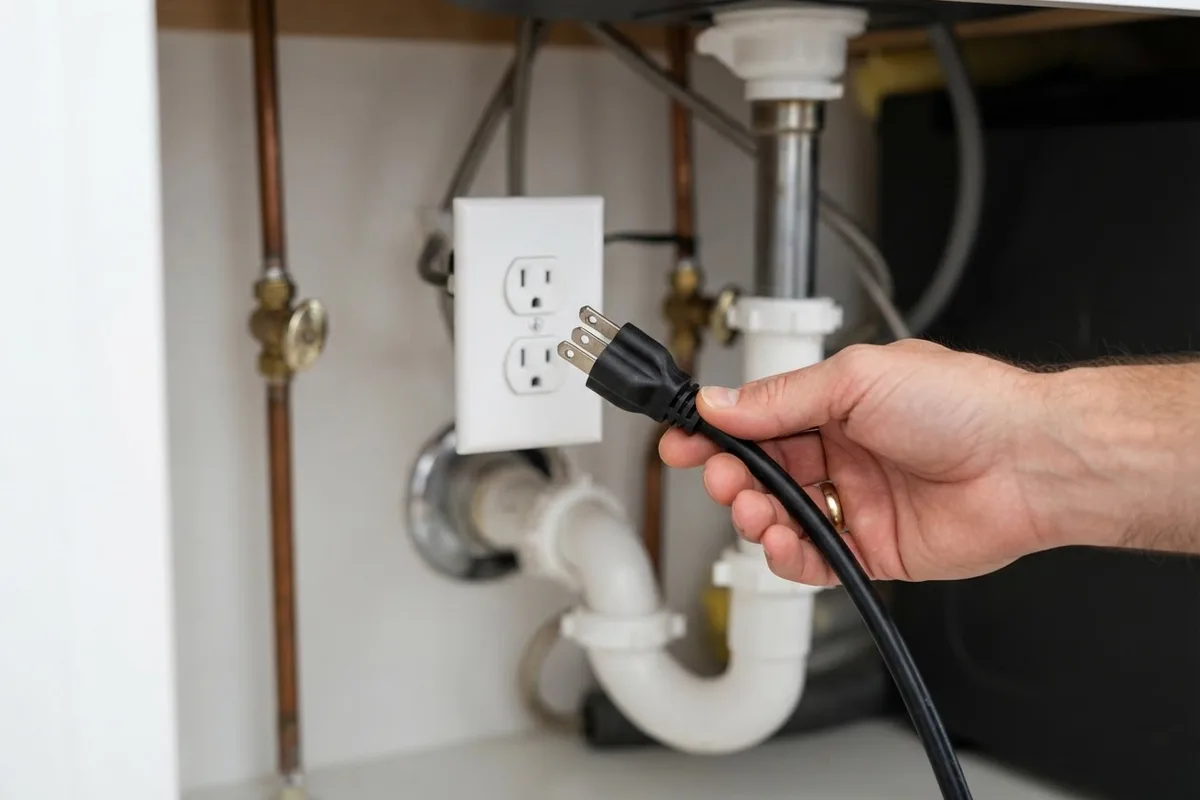
Many modern dishwashers plug into a GFCI-protected receptacle inside the adjacent sink cabinet rather than being hardwired directly. Over time, humidity from plumbing pipes, jostled cleaning caddies, or a loose plug can cause heat buildup or moisture arcing that trips the GFCI button or main panel breaker.
- Keep the circuit breaker OFF and open the cabinet doors under your kitchen sink.
- Look closely at the dishwasher power cord where it passes through the cabinet wall; check for pinched insulation, rodent chew marks, or melted plastic.
- Unplug the cord and inspect the metal prongs and outlet slots for dark scorch marks, green corrosion, or dampness.
- Feel around the surrounding plumbing traps and supply lines to confirm slow drips are not landing on the receptacle.
If you spot scorched prongs, melted plastic, or dampness inside the outlet box, leave the unit unplugged and have a professional replace the damaged cord or receptacle before running another load. You can also review our guide on how to prevent appliance leaks to keep under-sink cabinets dry.
3. Test Whether the Heating Element Is Shorting Out
A grounded or blistered heating element is one of the most common culprits when a dishwasher runs fine for 20 minutes and then suddenly snaps the breaker. When the outer metal sheath cracks, water seeps inside the coil and creates a direct short to ground the moment the control board energizes the heater.
- With power still OFF at the breaker, pull out the bottom dish rack.
- Run a flashlight along the circular metal heating loop at the floor of the tub (note that some European-style models hide an inline heater underneath instead).
- Look for white mineral blisters, splits, burn spots, or sections where the metal tube looks warped or swollen.
- Restore power briefly and run a quick rinse-only cycle with Heated Dry and Hi-Temp Wash turned off.
If the rinse-only cycle completes without tripping the breaker, the heating circuit is almost certainly the source of the fault. Replacing an exposed heating element typically costs $120 to $250 with professional installation, though pricing varies by area and model.
4. Look Under the Base for Hidden Water Leaks
Water and electricity sit inches apart beneath your dishwasher tub. A worn pump seal, loose hose clamp, or cracked sump housing can drip water directly onto the drain pump motor, circulation motor, or main wire connections, causing an immediate ground-fault trip.
- Turn OFF the circuit breaker and shut off the water supply valve under the sink.
- Unscrew the two to four mounting screws holding the bottom kickplate (toe panel) at the floor of the dishwasher and set the panel aside.
- Shine a bright flashlight across the floor and drip pan underneath the tub—do not reach inside if you see standing water.
- Look for active water droplets hanging from the central motor assembly, water inlet valve, or rubber hose connections, as well as chalky white mineral trails from past leaks.
If you find moisture near electrical motors or harnesses, soak up accessible water on the floor with a dry towel while the breaker remains off, and pause DIY work until the leak source is repaired. Undetected moisture issues can also explain why a dishwasher stops mid-cycle before finishing its wash.
5. Check the Junction Box Wiring Behind the Kickplate
Hardwired dishwashers connect house wiring to the appliance harness inside a small metal junction box mounted right behind the lower access panel. Years of subtle wash-cycle vibration combined with heating and cooling cycles can loosen twist-on wire connectors, allowing bare copper to arc against the metal box.
- Confirm the dishwasher breaker is OFF and double-check with a non-contact voltage tester held near the junction box before touching a screwdriver to it.
- Remove the single screw securing the small metal junction box cover behind the kickplate.
- Visually inspect the wire nuts inside for brittle, cracked, or melted plastic caps, charred insulation, or loose strands of wire.
- Make sure the metal strain-relief clamp holding the house cable into the box is snug so the wires cannot rub against sharp sheet-metal edges.
If the wire nuts look intact and undamaged, gently check that they are twisted tight, replace the metal cover, and test a cycle. If you discover melted connectors or blackened copper, stop immediately—heat-damaged wire ends must be trimmed back and properly re-terminated by an experienced technician.
6. Pay Attention to Wash and Drain Motor Timing
Paying attention to the exact minute the breaker trips gives you a reliable clue about which internal motor is drawing excessive current. Seized bearings, jammed glass shards in the drain impeller, or failing motor windings cause amperage spikes that trip thermal-magnetic breakers.
- Note whether the trip happens the instant you press Start (usually the drain pump running an initial purge or a door-latch wiring short).
- Listen if the breaker trips two to three minutes in, right after water fills the tub—that points to a locked-up main wash circulation motor.
- Notice if the unit hums loudly for several seconds right before power cuts out, which signals a jammed motor struggling to spin.
- Turn OFF power at the breaker, remove the bottom rack and tub filter, and carefully check the sump pit with heavy work gloves for broken glass or fruit pits blocking the drain area.
| When the Breaker Trips | Most Likely Cause | Safe Homeowner Action |
|---|---|---|
| Immediately when pressing Start | Shorted door harness or jammed drain pump | Check sump for debris with power off |
| 2–5 minutes into cycle (after fill) | Seized circulation wash motor | Stop using unit; schedule motor test |
| Mid-cycle or at the end of wash | Grounded heating element | Test a cold rinse cycle without Heated Dry |
| Only when other appliances run | Overloaded shared kitchen circuit | Unplug countertop heaters/appliances |
| Randomly, even when idle | Moisture in junction box or bad GFCI/AFCI | Shut off breaker; inspect under-sink area |
When to Call a Pro
While unplugging competing countertop gadgets or spotting a leak from behind the kickplate are smart homeowner checks, electrical faults inside wet appliances require caution. Stop troubleshooting and leave the breaker off if you smell burning plastic, see scorch marks on outlets or wire nuts, find water dripping onto motor housings, or suspect the breaker itself is weak inside your home's main electrical panel.
Typical professional dishwasher repairs—such as replacing a shorted heating element, faulty circulation motor, or damaged wiring harness—range from roughly $150 to $375 total, though exact costs vary by area and model. If you need safely diagnosed dishwasher repair, True Appliance Repair can match you with an experienced local appliance pro to get your kitchen running smoothly again.
FAQ
Is it safe to keep resetting a dishwasher breaker that trips?
No. Resetting the breaker once to test whether a shared countertop appliance caused an overload is fine, but repeatedly flipping a tripping breaker back on is dangerous. Each trip pushes heat through a shorted component or loose wire, increasing the risk of melted wiring or an electrical fire.
Why does my dishwasher trip the AFCI or GFCI breaker when it isn't even running?
Modern kitchens often require dual-function AFCI/GFCI breakers that detect tiny current leaks between neutral and ground wires even when the dishwasher control panel is asleep. Condensation inside the door console, a slow drip reaching the lower junction box, or a failing electronic noise filter can trip a sensitive GFCI breaker while the machine sits idle.
Can a bad circuit breaker trip even if my dishwasher is fine?
Yes. Breakers are mechanical safety switches that wear out over time, especially if they have tripped multiple times in the past or run near capacity for years. If an appliance technician tests your dishwasher's heater, motors, and wiring and finds normal amperage draw with zero ground faults, an electrician should inspect the breaker in your panel.
Why did my dishwasher take longer right before it started tripping the breaker?
A failing heating element often degrades before shorting out completely, preventing the water from reaching target wash temperatures on schedule. Because modern dishwashers pause the timer until internal sensors confirm hot water, a weak heater can explain a dishwasher taking too long in the weeks leading up to a hard breaker trip.