
Walking into the kitchen to find your oven door locked shut—especially with dinner inside or right after a cleaning cycle—is instantly frustrating. Modern electric and gas ranges use motorized latches and safety locks that frequently get stuck due to excess heat, control board glitches, or activated child locks. Before you pull hard on the handle and risk shattering the glass or bending the latch hook, work through these six safe DIY methods to get your oven door open again.
Safety First: Never pry an oven door open with a screwdriver, putty knife, or heavy force while the lock mechanism is engaged. Before attempting any manual latch release or wiring check, unplug the oven from the wall outlet or switch off its dedicated circuit breaker at your home's electrical panel. If you have a gas range, never disturb the flexible gas supply line behind the unit.
1. Let the Oven Cool Down Completely
If your oven door locked during or right after a self-cleaning cycle, the culprit is almost always heat. Self-clean cycles push interior temperatures past 800°F, and a built-in thermal switch keeps the motorized latch locked until the cavity drops back down to a safe temperature—typically below 500°F. Even if the display says the cycle is finished, the lock will not budge until the internal temperature sensor registers that cooldown.
- Press the Cancel or Off button once to make sure the heating elements are completely shut down.
- Leave the oven completely alone for 60 to 90 minutes. Do not unplug the unit yet, because the internal cooling fan needs electricity to vent trapped heat.
- Watch the control panel for the "Locked" or padlock indicator light. Once the light stops blinking and turns off completely, gently test the handle.
- Once you get the door open, double-check that your oven isn't running hotter than it should by reading our guide on how to calibrate an oven for accuracy.
2. Turn Off the Control Panel Child Lock
Many homeowners accidentally trigger the child safety lock while wiping down the touch panel or leaning against the range. Unlike a self-clean lock that only engages at high heat, the control lock feature can physically latch the oven door and freeze the keypad while the oven is stone cold. Look at your display for a tiny padlock icon, the letters "Loc," or "L" next to the clock.
- Locate the button on your touchpad labeled Control Lock, Lock, or marked with a small key or padlock symbol. On many models, this function is tied to the Start or Cancel/Off button.
- Press and hold that specific button continuously for 3 to 5 seconds.
- Listen for an audible beep and watch the display for the padlock icon to disappear, followed by the soft whirring sound of the motorized latch retracting.
- If your model uses a two-button combination (such as holding Bake and Broil together for 3 seconds), check the sticker inside the bottom storage drawer or your model manual for the exact key sequence.
3. Perform a Hard Power Reset at the Breaker
Sometimes the oven has cooled down completely, yet the electronic control board freezes and forgets to send the electrical signal that retracts the motorized door latch. Performing a hard power reset clears temporary memory glitches in the main relay board and forces the latch motor to recalibrate its position as soon as power returns.
- Make sure the oven is completely cool to the touch on the outside.
- Walk to your home's main electrical breaker panel and flip the double-pole breaker labeled "Range" or "Oven" (or the standard 120V breaker for a gas range) to the Off position.
- Wait a full 5 minutes. This gives the capacitors on the electronic control board enough time to drain all residual electrical charge.
- Flip the breaker back to the On position and return to the kitchen.
- Listen closely during the first 30 seconds after power is restored. Most modern ovens run an automatic self-test on startup that cycles the latch motor back to the unlocked position.
4. Cycle the Self-Clean Function On and Off
If a power reset does not wake up a stuck latch motor, briefly starting and canceling a new self-clean cycle can jolt the motor cam into completing its rotation. The latch mechanism runs on a small synchronous motor with a rotating metal cam; if that cam stops at a dead spot, commanding it to lock and immediately unlock again often frees it up.
- Push firmly inward on the oven door handle and hold it there. Putting gentle inward pressure on the door takes mechanical tension off the metal latch hook inside the slot.
- While holding the door slightly inward, press the Self-Clean button and press Start.
- Wait about 15 to 20 seconds so the latch motor engages and completes a full locking movement.
- Press Cancel or Off while still keeping light inward pressure on the door handle.
- Wait 30 to 60 seconds for the motor to reverse direction. Once the lock light shuts off and the whirring stops, pull the handle gently to open the door.
5. Release a Manual Latch Lever With a Coat Hanger
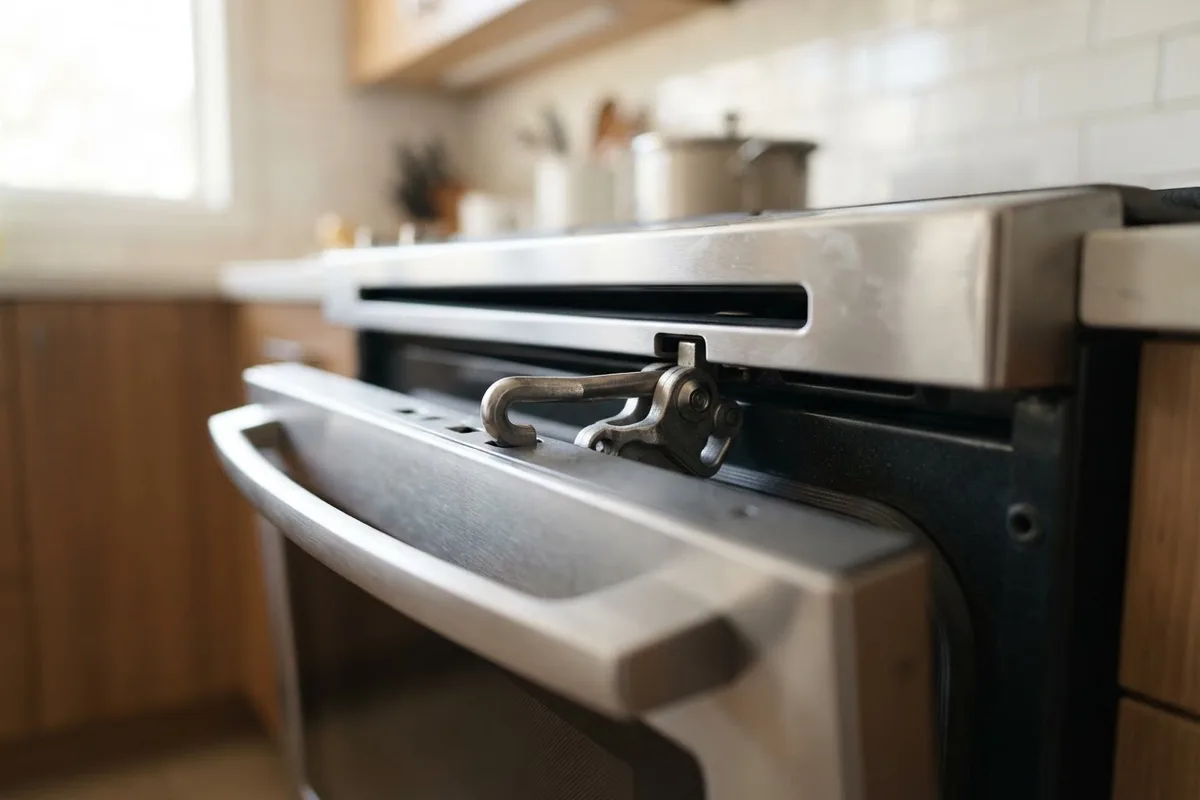
Older ovens—and a few modern budget models—use a manual sliding metal lever right above the oven door rather than an electric motor, while others have a hidden mechanical release catch in the narrow gap between the top of the door and the control console. If the metal hook is simply jammed against the door strike plate, you can often slide it free once the power is off.
- Turn off the circuit breaker to the oven so there is zero risk of touching a live wire or heating element.
- Shine a bright flashlight into the narrow horizontal gap between the top edge of the oven door and the bottom lip of the cooktop or control panel.
- Locate the curved metal latch hook near the center of the door frame.
- Straighten a sturdy wire coat hanger and bend a small, smooth half-inch hook at the very tip using pliers.
- Push inward on the oven door with your knee or free hand to relieve tension on the latch, then slide the coat hanger wire into the gap, catch the metal latch hook, and gently nudge it to the left or right (whichever direction releases it from the slot).
- Never yank hard; if the hook is attached to a motorized gear assembly, forcing it will strip the internal gears.
6. Inspect the Door Latch Switch Under the Cooktop
If you are comfortable using basic hand tools and the door remains locked cold, you can access the latch assembly from above on most freestanding ranges by lifting the main top panel. Over time, grease vapor or heat can jam the linkage rod that connects the rear latch motor to the front door hook.
- Unplug the range or shut off the breaker at the electrical panel. Never open an appliance cabinet with the power connected.
- On an electric coil or gas stove, remove the grates or burners (if you also have a burner acting up, check our guide on why an electric stove burner is not heating).
- Remove the two to four mounting screws located along the front lip under the cooktop edge or inside the top door frame, then carefully prop up the main top panel just a few inches.
- Locate the metal latch assembly at the front center and carefully manually rotate the motor cam or slide the metal linkage arm backward until the hook clears the door catch.
- Inspect the micro-switch wires attached to the latch assembly. If a wire connector has burned or slipped off, the control board cannot tell whether the door is open or closed.
Quick Troubleshooting Reference: Locked Oven Door
| Symptom | Most Likely Cause | Recommended DIY Fix | Typical Part / Repair Cost* |
|---|---|---|---|
| Lock light blinking right after self-clean | Oven interior is still above 500°F | Wait 60–90 minutes for full cooldown | $0 (Normal operation) |
| "Loc" or padlock icon on cold oven | Child Control Lock activated | Hold "Lock" or "Start" button for 3–5 seconds | $0 (Keypad reset) |
| Lock light stays solid on cold oven | Frozen control board relay | Turn off breaker for 5 minutes to reset | $0 (Hard power reset) |
| Clicking noise from top of door | Jammed latch hook or cam | Push door inward while canceling Self-Clean | $0–$120 (Latch adjustment) |
| Latch motor hums or doesn't move at all | Failed motorized door latch assembly | Replace latch motor or call a pro | $150–$320 (Parts & labor) |
| Oven shows F9 or F90 error code | Faulty door lock switch or wiring | Inspect switch under top panel or call a pro | $160–$350 (Parts & labor) |
Prices represent broad US averages and vary by area, appliance brand, and model.
When to Call a Pro
While cooldown waits, keypad unlocks, and breaker resets solve the majority of stuck oven doors, some failures require component replacement inside the range cabinet. You should stop DIY troubleshooting and call a professional if your display flashes persistent fault codes (such as F9, F90, or E1), if you smell burnt electrical insulation coming from the control panel, or if accessing the latch requires removing a fragile ceramic glass cooktop or moving a heavy built-in wall oven.
Replacing a motorized door latch assembly, a faulty oven temperature sensor (RTD probe), or a shorted main control board typically runs between $150 and $350 depending on your range model and local rates (see our appliance repair cost guide for help deciding when a repair makes financial sense). If your door still won't budge, True Appliance Repair can match you with an experienced local pro for fast, dependable oven and stove repair.
FAQ
Why did my oven door lock by itself when I wasn't using self-clean?
An oven door usually locks on its own for one of two reasons: someone accidentally brushed the keypad and turned on the Child Control Lock, or a brief household power flicker caused the electronic control board to misfire and cycle the latch motor. Try holding the Control Lock button for 3 seconds first, and if that fails, reset the oven's circuit breaker for 5 minutes.
How long does it take an oven door to unlock after self-cleaning?
After a self-cleaning cycle ends or is canceled midway, it typically takes 45 to 90 minutes for the oven cavity to cool down below 500°F. Until the internal temperature sensor detects that the oven has dropped to a safe level, the thermal lock will keep the door bolted shut to prevent flash burns.
Can I force my locked oven door open in an emergency?
You should never yank or pry a locked oven door open with tools. Forcing the handle will bend the metal latch rod, strip the motorized latch gears, or shatter the tempered glass door panel—turning a simple reset into a $300+ repair. If food inside is smoking heavily, keep the door closed to starve the smoke of oxygen and shut off the oven breaker immediately.
Why is my oven latch clicking repeatedly and refusing to open?
A repetitive clicking or grinding noise near the top of the oven door means the latch motor is trying to turn, but the metal hook is either jammed against the door slot or the plastic gears inside the motor housing are stripped. Push firmly inward on the oven door handle to take pressure off the hook while pressing Cancel; if the clicking continues, the motorized latch assembly will need to be replaced.